
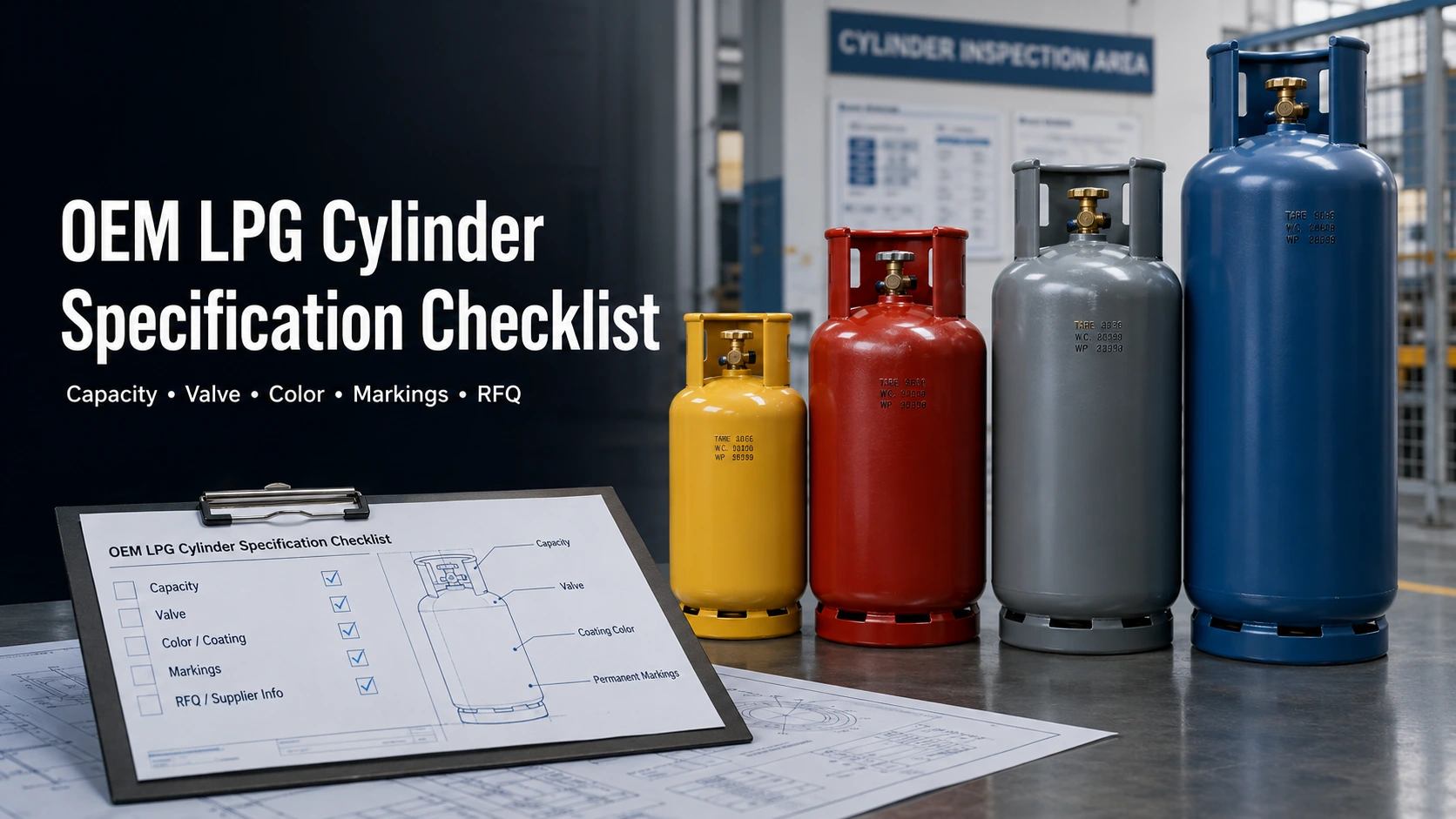
An OEM LPG cylinder specification checklist should convert market requirements into a cylinder that can be quoted, sampled, filled, distributed, and reordered without ambiguity. For a distributor, importer, or private-label gas company, that means defining the destination market, capacity, dimensions, valve, coating, markings, artwork, packaging, and approval process. Missing information can produce misleading quotations or a cylinder that does not match the local filling network.
An inquiry that states only “12.5 kg LPG cylinder, red, with logo” leaves critical questions unanswered. Fill mass does not define water capacity or dimensions. A color name does not define a paint code or coating requirement. A valve photograph may not identify its thread, outlet, or regulator compatibility. The result is repeated clarification and quotations based on different assumptions. A complete RFQ should start with market and operating requirements rather than appearance.
The destination country may determine the applicable cylinder specification, accepted valve connection, required markings, label language, and filling practice. The same nominal cylinder may not suit two markets if their equipment or regulators differ.
Identify the country of sale, application, distribution model, filling partner, and connected regulator before selecting details. If local requirements are uncertain, obtain confirmation from the responsible authority, filling company, or qualified local technical partner. Copying a cylinder sold elsewhere is not sufficient unless its specification is valid for the new market.
Separate non-negotiable technical requirements from commercial preferences. Applicable specifications, fill capacity, valve compatibility, traceability, and safety markings normally belong in the first group. Logo design, brand color, label layout, and packaging usually belong in the second.
This prevents artwork from covering permanent markings and cosmetic changes from altering an approved configuration. Mark each RFQ field as mandatory, preferred, or supplier-proposed. If branding conflicts with a regulatory or filling requirement, the mandatory condition takes priority and should be resolved before drawing or sampling.
LPG fill weight and water capacity describe different things and should be separate RFQ fields. Tare weight affects filling and handling, while diameter and total height affect racks, cages, pallets, and vehicles. State whether total height includes the valve, guard, or cap.
Two cylinders carrying the same kilograms of LPG may have different dimensions or empty weights. The relationship varies by design, material, configuration, and applicable specification. Confirm fill mass, water capacity, tare-weight tolerance, diameter, height, and the production drawing revision.
Replacement procurement requires more than a front-view photograph. Collect images of permanent markings, the valve, regulator connection, guard, and foot ring, plus measured diameter and height. Existing specifications, approval documents, packaging details, and an actual sample are useful when available.
If the cylinder has unclear markings or a replacement valve, it may not be a reliable master sample. Verify the configuration independently, then compare the existing unit, proposed drawing, and destination-market requirements.
Also record whether the stated tare includes the valve and any permanently attached components. Reusable racks or cages should be measured for clearance before a replacement design is approved.
A valve should not be selected by appearance or outlet diameter alone. Confirm the model, cylinder-neck thread, outlet connection, operating direction, intended LPG service, filling equipment, and regulator compatibility. Other valve details depend on the applicable specification and market.
For an unfamiliar destination, provide a dimensioned drawing and, when practical, a reference sample. The filling company or local technical team should approve the connection before production, especially where visually similar valve types circulate. Written approval reduces the risk of cylinders that cannot be filled or connected.
Every quotation should state whether the valve is included, who installs it, and which accessories form part of delivery. A low unit price may exclude the valve, cap, regulator, or packaging assumed by the buyer. Installation responsibility also affects tare weight and final inspection.
Request the valve specification, markings, drawing, and sample-approval method. Confirm protection during loading and handling. Any alternative valve proposed after approval should be treated as a controlled change, not an automatic substitution.
Where the valve is sourced separately, assign responsibility for thread compatibility, assembly, leak testing, and the final approved tare value.
“Blue” or “red” is not an adequate coating specification. Determine whether the destination market, filling company, or owner requires an identification color, then define the brand color with a recognized reference or physical sample. State finish and gloss when consistency matters.
Color approval does not replace coating approval. Verify surface preparation, coating system, exposure conditions, and acceptance criteria against the product specification. Humid storage, coastal distribution, or frequent recirculation may change purchasing requirements. Keep the approved color chip and coating specification with the drawing.
Cylinder markings support identification, inspection, and traceability; they are not merely branding space. ISO 13769 addresses stamp marking for transportable gas cylinders, including LPG cylinders, while individual markets may add other requirements.
Create a layout separating permanent manufacturing and technical information from owner identification, warnings, labels, and artwork. Confirm languages, location, legibility, and space for later inspection marks where applicable. A logo may be customizable, but it should not conflict with mandatory information. Approve the final artwork and marking drawing before production.
Approval should move from documents to physical evidence. Begin with a specification sheet and controlled drawing, then confirm the valve, color, marking layout, artwork, and packaging. Check a pre-production sample against those records.
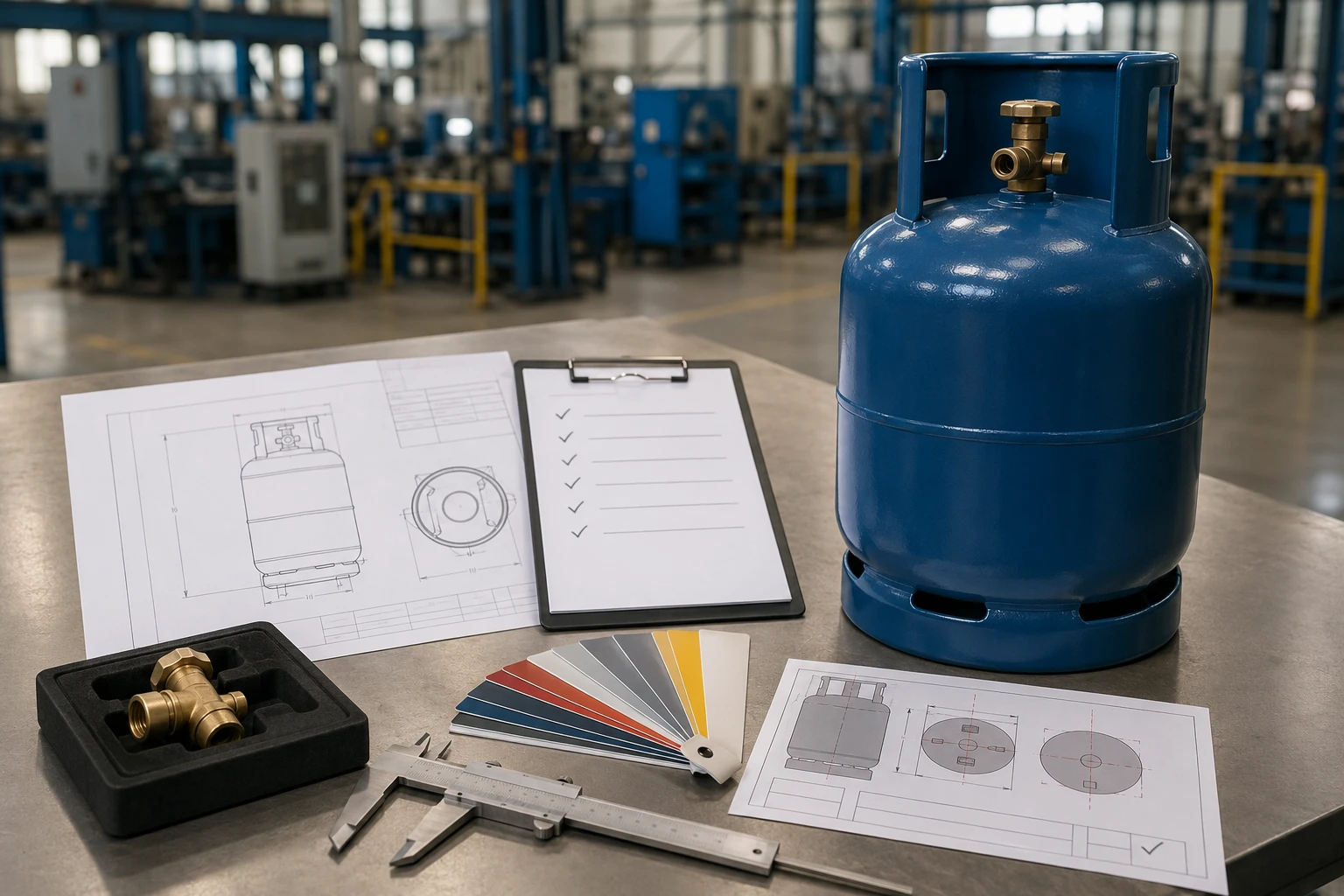
Photographs may hide dimensions, thread details, finish differences, or marking depth. Record the approved sample, drawing revision, artwork version, and date. If a deviation is accepted, update the controlling document before final inspection.
The sample review should also confirm handling clearances, label adhesion, packaging fit, and whether all technical information remains readable after coating and assembly.
Repeatability matters to distributors maintaining a cylinder pool or private-label line. The purchase agreement should identify which changes require approval, including dimensions, valve configuration, material, coating, color, markings, and packaging.
For repeat orders, compare the new quotation and drawing with the last approved revision. Require substitutions to be disclosed before production. A reference sample and version-controlled specification provide a common basis for resolving questions and preventing specification drift.
Purchase records should identify the controlling revision and require written approval before that revision is replaced.
Convert every assumption into a measurable RFQ field or approval record.
| Common mistake | Purchasing risk | Preventive action |
|---|---|---|
| Nominal fill weight only | Wrong capacity or dimensions | Confirm fill mass, WC, tare, diameter, and height |
| Valve chosen by appearance | Filling or regulator mismatch | Approve model, threads, outlet, drawing, and sample |
| Color treated as decoration | Market conflict or inconsistent finish | Confirm market rules, color reference, and coating |
| Logo sent without a layout | Mandatory information becomes unclear | Approve markings, labels, position, and language |
| Photographs used as approval | Hidden dimensional or finish differences | Use drawings and a reference sample |
| Quotations have different scopes | Low price excludes required items | Normalize valve, coating, packaging, and documents |
A useful checklist should let every supplier quote the same scope. Include:
Buyers who have not finalized the capacity can compare the available export LPG cylinder range before freezing dimensions and valve requirements.
Place technical scope beside price. Check whether each quotation includes the same valve, finish, markings, packaging, documents, inspection activities, and sample process. Record supplier exceptions rather than treating silence as acceptance.
If one supplier quotes an assembled cylinder and another excludes the valve or customized marking, their unit prices are not comparable. Transfer the final specification, approved drawing, and accepted clarifications into the purchase agreement.
Add a clear assumptions-and-exceptions column so unresolved technical items remain visible before final commercial approval.
Evaluate an OEM supplier on its ability to translate requirements into controlled production records. Look for relevant technical questions, drawing approval, revision control, defined inspection records, and a practical response when a requested valve or marking conflicts with the destination market.
Mintai Cylinder specializes in LPG cylinder manufacturing and presents multiple export-oriented sizes through its 液化石油气钢瓶制造商 website. Buyers can review about Mintai Cylinder when assessing its stated manufacturing and OEM focus. Apply the same specification, sample, documentation, and change-control checklist to any candidate. A credible response should identify missing information rather than quote an undefined configuration.
A successful OEM order begins with a frozen specification. Confirm the destination market and filling system first; then define capacity, dimensions, valve compatibility, coating, markings, branding, packaging, and approval records. Use the same baseline for samples, quotations, inspection, and repeat orders.
When contacting Mintai Cylinder for a technical review, buyers can request an OEM LPG cylinder quotation and submit the destination country, required capacity, dimensions, valve drawing or sample, color reference, artwork, operating environment, order quantity, and any existing-cylinder photographs. These details give the supplier a practical basis for identifying gaps and proposing the next step.
Provide the market, applicable specification, capacity, dimensions, valve, color, markings, artwork, packaging, quantity, and required documents. Include drawings or photographs for replacement orders.
Fill weight is the intended LPG mass; water capacity describes internal volume measured with water. Confirm both with tare weight and dimensions.
No. It must also match the cylinder connection, outlet, filling equipment, regulator, LPG service, and market requirements. Approve a drawing or sample.
It depends on market rules, required identification, coating specifications, and available marking space. Branding must not conflict with mandatory information.
Approve the drawing, valve, color reference, marking layout, artwork, packaging, and physical sample. Record revisions and deviations before production.