
ข่าว

หมวดหมู่ข่าว

สารบัญ

    ข่าวล่าสุด

    Working Pressure Test Pressure and Burst Pressure in LPG Cylinder Procurement
      Working pressure, test pressure, and burst pressure describe different parts of an LPG cylinder’s...
    How to Verify LPG Cylinder Size Compatibility Before Reordering
      LPG cylinder size compatibility cannot be confirmed from the nominal kilogram or pound rating...
    Semi-Finished LPG Cylinder Parts: A Complete Guide for Cylinder Manufacturers
      For cylinder manufacturers, semi-finished LPG cylinder parts are the point where purchased inputs...
    LPG Cylinder Deep Drawing Process: How Steel Discs Become Cylinder Halves
      The LPG cylinder deep drawing process converts a flat circular steel disc into a shaped shell...
    Steel Blanks for LPG Cylinder Deep Drawing
      A good steel blank for LPG cylinder deep drawing is not simply a round piece of metal with the...
    LPG Cylinder Steel Discs: Blanking and Deep Drawing
      An LPG cylinder begins as flat steel, but the reliability of the finished pressure vessel is...
    LPG Cylinder Capacity in kg vs Litres Gas Capacity, Water Capacity & B2B Selection Guide
      When an LPG cylinder is described as 9kg, 20kg, 45kg, 47.7L, or 108L, those numbers do not necessarily...
    45kg LPG Cylinder Dimensions, Tare Weight & Capacity B2B Specification Guide
      A 45kg LPG cylinder is identified by its nominal gas capacity, but that number does not define...
    What Is an LPG Cylinder Guard Ring? Valve Protection, Manufacturing and Buyer Checks
      An LPG cylinder guard ring is the protective structure around the valve area at the top of a gas...
    How Are LPG Cylinder Foot Rings Made? Forming, Welding, Corrosion and Quality Checks for Buyers
      An LPG cylinder foot ring is the support structure at the bottom of a cylinder that helps it stand...
    Working Pressure Test Pressure and Burst Pressure in LPG Cylinder Procurement
    How to Verify LPG Cylinder Size Compatibility Before Reordering
    Semi-Finished LPG Cylinder Parts: A Complete Guide for Cylinder Manufacturers
    LPG Cylinder Deep Drawing Process: How Steel Discs Become Cylinder Halves
    Steel Blanks for LPG Cylinder Deep Drawing
    LPG Cylinder Steel Discs: Blanking and Deep Drawing
    LPG Cylinder Capacity in kg vs Litres Gas Capacity, Water Capacity & B2B Selection Guide
    45kg LPG Cylinder Dimensions, Tare Weight & Capacity B2B Specification Guide
    What Is an LPG Cylinder Guard Ring? Valve Protection, Manufacturing and Buyer Checks
    How Are LPG Cylinder Foot Rings Made? Forming, Welding, Corrosion and Quality Checks for Buyers

    ติดต่อเรา

    LPG Cylinder vs Propane Cylinder: 2026 Importer Safety & Compliance Checklist

    LPG Cylinder vs Propane Cylinder 2026 Importer Safety & Compliance Checklist

    lpg-cylinder-vs-propane-cylinder

    Why LPG and Propane Cylinders Are Frequently Confused

    In global gas equipment sourcing, the terms LPG cylinder and propane cylinder are frequently used as if they describe the same product. However, importers learn fairly soon that they do not always have the same behavior once regulatory matters, filling processes, and customs inspections are involved.

    As far as imports are concerned, most problems are related more to the specifications of the cylinder than to the gas it contains. The pressure ratings, valve configuration, marking, and compliance papers are the elements that make the difference between a successful inspection and a delayed shipment.

    LPG typically refers to a mixture of propane and butane, while propane is a single-component gas with more stable vapor characteristics. The difference is technical, but it directly affects cylinder design requirements and how local markets approve usage.

    กระบอกมินไท is a welded steel LPG cylinder manufacturer based in China, supplying export markets with a range of standard household and commercial cylinder sizes. In most projects, the focus is less on branding and more on keeping specifications aligned with the destination country’s safety rules and filling systems.

    Key Technical Differences in Gas and Usage

    Gas behavior is only part of the equation

    Propane generally has higher and more stable vapor pressure, especially in low-temperature environments. LPG mixtures vary depending on the propane-to-butane ratio, which makes performance less predictable across regions.

    This difference affects:

    • Filling pressure limits
    • Regulator performance stability
    • Safety valve calibration requirements
    • Seasonal usage behavior

    In colder regions, propane-heavy systems are more common because they reduce pressure drop issues during winter. In warmer markets, LPG blends are often preferred for flexibility and availability.

    Naming conventions do not reflect compliance rules

    One recurring issue in global sourcing is assuming product names equal technical standards.

    • “Propane cylinder” is commonly used in North America and colder regions
    • “LPG cylinder” is more common across Asia, Africa, and Latin America
    • In many catalog systems, both terms are used loosely

    However, regulators and filling stations usually ignore naming. What they check instead is:

    • Working pressure rating
    • Valve compatibility
    • Certification standard
    • Physical markings and traceability

    This is where import mismatches usually appear.
     

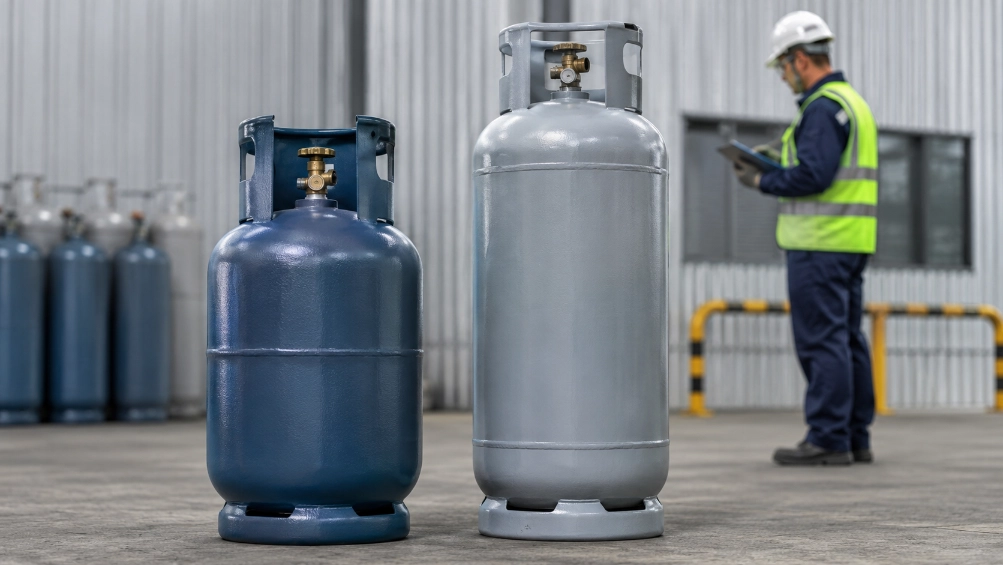
    industrial-lpg-propane-cylinder-comparison-warehouse

    Import Safety Checklist for 2026 Procurement Decisions

    Cylinder specification alignment with destination market

    Before confirming bulk orders, importers typically verify:

    • Water capacity (commonly 3kg to 45kg depending on market use)
    • Tare weight consistency across production batches
    • Working pressure and test pressure requirements
    • Dimensional compatibility for transport and storage systems

    Even small inconsistencies can affect downstream filling operations, especially in markets with strict calibration systems.

    Valve compatibility with local infrastructure

    Valve mismatch is still one of the most common rejection points in international shipments.

    Key verification points include:

    • Thread standard and connection type
    • Regulator interface compatibility
    • Safety relief system design
    • Local filling station acceptance

    A cylinder body that fully meets structural requirements can still be rejected if the valve does not match local systems.

    Marking and traceability requirements

    Most import destinations require permanent identification markings for safety tracking:

    • Manufacturing date
    • Batch or serial number
    • Water capacity and tare weight
    • Test pressure marking
    • Standard reference code

    These markings are often reviewed before physical inspection during customs clearance.

    Testing documentation requirements

    Compliance is usually confirmed through supporting test records, including:

    • Hydraulic pressure testing
    • Leak detection reports
    • Weld quality inspection records
    • Material traceability certificates

    In many cases, documentation review happens before cargo inspection, especially for pressure vessel products.

    Cylinder Design and Manufacturing Factors

    Structural consistency of steel cylinder body

    ถังแก๊ส LPG are pressure vessels, which means structural stability directly affects long-term safety.

    Key focus areas include:

    • Steel grade consistency (commonly HP295 / Q235B in export production)
    • Welding seam uniformity
    • Cylindrical shape accuracy
    • Pressure cycle durability

    In large-volume export shipments, batch consistency often matters more than individual unit performance.

    Surface protection and environmental durability

    In real use conditions, coating quality plays a major role in service life.

    Common field issues include:

    • Corrosion near valve neck areas
    • Paint peeling during transport handling
    • Rust formation in humid or coastal environments

    These issues usually appear after delivery, not during factory inspection, which is why coating stability is closely monitored in export production.

    Supplier Capability and Risk Control in Bulk Importing

    Production stability matters more than product design

    In B2B cylinder sourcing, consistency is often more important than design variation.

    Importers usually evaluate:

    • Batch-to-batch weight stability
    • Valve installation accuracy
    • Coating uniformity across production runs
    • Pre-shipment inspection rate

    Mintai Cylinder operates automated production lines for welded steel LPG cylinders, supporting consistent output across different standard sizes used in household and commercial markets.

    Documentation readiness for export markets

    Different regions may require different compliance documents, but most markets expect:

    • Test reports for pressure and leakage
    • Material certificates with traceability
    • Batch production records
    • Loading and packaging details

    Delays in customs are often caused by incomplete paperwork rather than physical product issues.

    Common Import Mistakes

    Even experienced buyers encounter avoidable issues:

    • Selecting suppliers purely based on unit price
    • Mixing LPG and propane specifications in one shipment
    • Overlooking regional valve standard differences
    • Skipping third-party inspection before shipment
    • Assuming one cylinder specification works globally

    Most of these problems only appear after arrival, when distribution has already started.

    Mintai Cylinder in Global Supply

    Mintai Cylinder focuses on steel LPG cylinder manufacturing for export-oriented markets, covering household, commercial, and industrial use scenarios.

    Typical production range includes:

    • Small cylinders: 3kg, 6kg, 9kg
    • Medium cylinders: 12.5kg, 15kg, 20kg
    • Large cylinders: 45kg / 100lbs

    In practice, many importers pay more attention to consistency across batches than to individual specifications. Even small variations in valve alignment or weight tolerance can affect filling efficiency in downstream operations.

    Customization is available depending on destination market requirements, including valve configuration, marking specifications, and packaging format.

    บทสรุป

    LPG cylinder and propane cylinder sourcing is less about terminology and more about compatibility. Once cylinder specification, valve system, pressure rating, and compliance documentation are aligned with the destination market, most operational risks naturally decrease.

    In global trade, the main challenge is rarely production quality alone—it is specification mismatch across different regulatory systems and filling infrastructures.

    Mintai Cylinder supports international buyers with welded steel LPG cylinder solutions designed for export compliance, stable production quality, and regional specification requirements. For bulk orders, technical specifications, or export compliance support, ติดต่อ Mintai Cylinder to get tailored cylinder solutions for your target market.

    FAQS

    Q1: What is the key difference between an LPG cylinder and a propane cylinder?

    A: LPG cylinders are designed for mixed gas compositions, while propane cylinders are optimized for higher and more stable pressure behavior in single-gas applications.

    Q2: Can LPG cylinders be used for propane applications?

    A: In some cases yes, but only when pressure rating, valve compatibility, and local regulatory standards match propane usage requirements.

    Q3: What should importers check before placing bulk LPG cylinder orders?

    A: Key checks include pressure rating, valve system compatibility, cylinder markings, test documentation, and destination certification requirements.

    Q4: Why are LPG cylinder shipments sometimes rejected during customs inspection?

    A: Common reasons include missing markings, incomplete test reports, incorrect valve systems, or non-compliance with local safety standards.

    Q5: What role does Mintai Cylinder play in export supply?

    A: Mintai Cylinder produces welded steel LPG cylinders in multiple standard sizes for household and commercial use, with production designed to meet export market specification requirements.

    แชร์โพสต์:

    ข่าวล่าสุด

    Working Pressure Test Pressure and Burst Pressure in LPG Cylinder Procurement
      Working pressure, test pressure, and burst pressure describe different parts of an LPG cylinder’s...
    How to Verify LPG Cylinder Size Compatibility Before Reordering
      LPG cylinder size compatibility cannot be confirmed from the nominal kilogram or pound rating...
    Semi-Finished LPG Cylinder Parts: A Complete Guide for Cylinder Manufacturers
      For cylinder manufacturers, semi-finished LPG cylinder parts are the point where purchased inputs...
    LPG Cylinder Deep Drawing Process: How Steel Discs Become Cylinder Halves
      The LPG cylinder deep drawing process converts a flat circular steel disc into a shaped shell...
    Steel Blanks for LPG Cylinder Deep Drawing
      A good steel blank for LPG cylinder deep drawing is not simply a round piece of metal with the...
    LPG Cylinder Steel Discs: Blanking and Deep Drawing
      An LPG cylinder begins as flat steel, but the reliability of the finished pressure vessel is...
    LPG Cylinder Capacity in kg vs Litres Gas Capacity, Water Capacity & B2B Selection Guide
      When an LPG cylinder is described as 9kg, 20kg, 45kg, 47.7L, or 108L, those numbers do not necessarily...
    45kg LPG Cylinder Dimensions, Tare Weight & Capacity B2B Specification Guide
      A 45kg LPG cylinder is identified by its nominal gas capacity, but that number does not define...
    What Is an LPG Cylinder Guard Ring? Valve Protection, Manufacturing and Buyer Checks
      An LPG cylinder guard ring is the protective structure around the valve area at the top of a gas...
    How Are LPG Cylinder Foot Rings Made? Forming, Welding, Corrosion and Quality Checks for Buyers
      An LPG cylinder foot ring is the support structure at the bottom of a cylinder that helps it stand...
    Working Pressure Test Pressure and Burst Pressure in LPG Cylinder Procurement
    How to Verify LPG Cylinder Size Compatibility Before Reordering
    Semi-Finished LPG Cylinder Parts: A Complete Guide for Cylinder Manufacturers
    LPG Cylinder Deep Drawing Process: How Steel Discs Become Cylinder Halves
    Steel Blanks for LPG Cylinder Deep Drawing
    LPG Cylinder Steel Discs: Blanking and Deep Drawing
    LPG Cylinder Capacity in kg vs Litres Gas Capacity, Water Capacity & B2B Selection Guide
    45kg LPG Cylinder Dimensions, Tare Weight & Capacity B2B Specification Guide
    What Is an LPG Cylinder Guard Ring? Valve Protection, Manufacturing and Buyer Checks
    How Are LPG Cylinder Foot Rings Made? Forming, Welding, Corrosion and Quality Checks for Buyers

    ติดต่อเรา

    ติดต่อเรา

    ผลิตภัณฑ์ที่เกี่ยวข้อง