
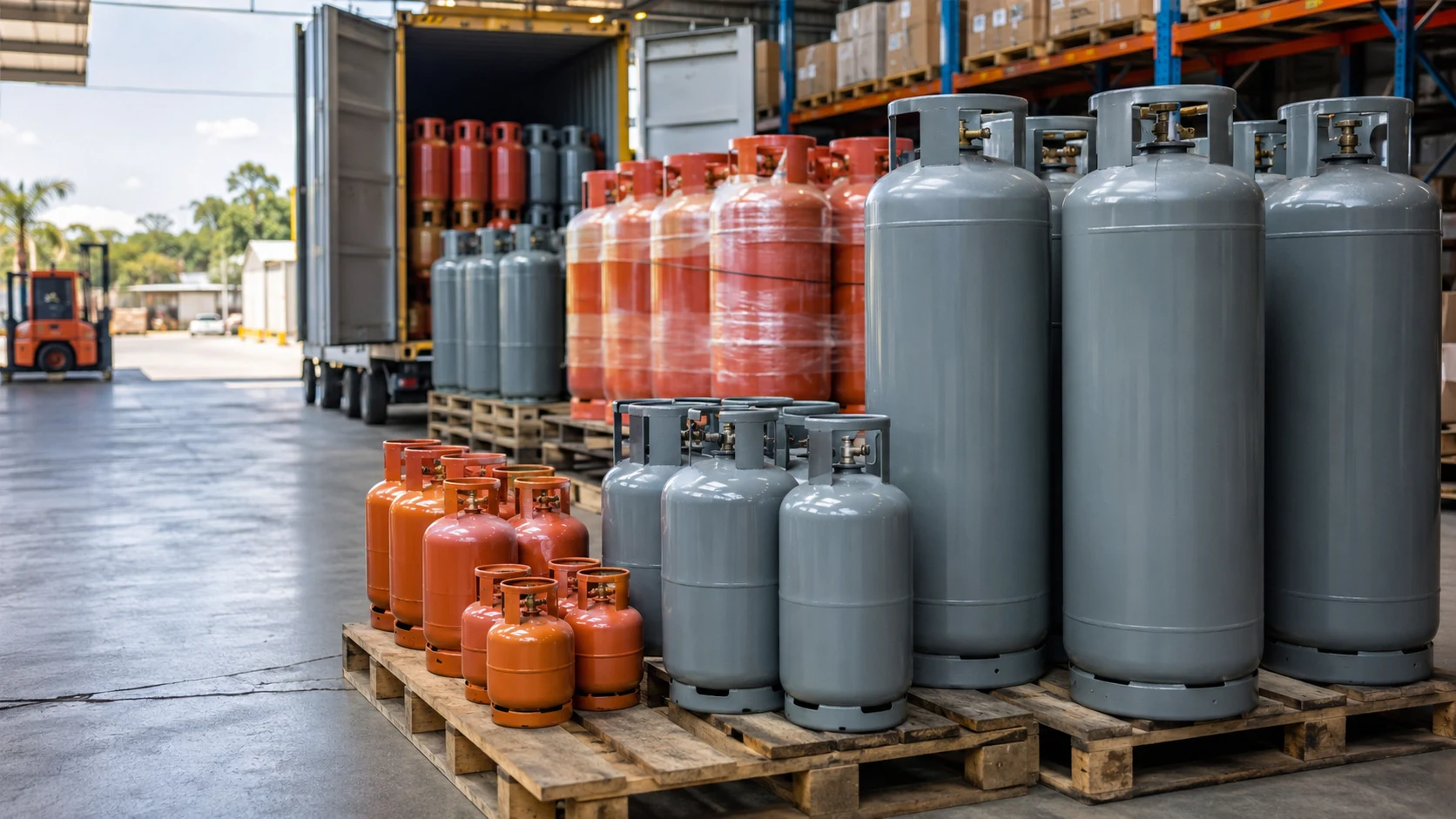
Selecting LPG cylinder sizes for distributors is not simply a matter of stocking small, medium, and large models. A size that sells well in one market may create slow inventory, frequent deliveries, or filling-system problems in another. The right choice depends on customer income, gas consumption, refill behavior, application, handling conditions, and local infrastructure. Distributors should therefore treat cylinder size selection as a demand-planning decision rather than copy another market’s product range.
Customers do not evaluate cylinder capacity in isolation. A household with irregular income may prioritize the cash required for one complete refill, while a restaurant may care more about reducing cylinder changes during operating hours. The World Bank notes that small cylinders in the 3–6kg range are easier to carry and cost less per refill, although their cost per unit of LPG can be higher.
This distinction matters in price-sensitive markets. A smaller LPG cylinder can reduce the payment required at the refill point, but it may also increase refill frequency, delivery activity, and customer inconvenience. Larger cylinders can support longer use between refills, yet their initial acquisition and full-refill costs may be beyond the budget of some households.
Before choosing sizes, distributors should investigate average household consumption, customer income patterns, typical refill spending, and how far customers travel to refill or exchange cylinders. These signals are more useful than assuming that the largest affordable cylinder will generate the strongest demand.
The same LPG cylinder size may serve different purposes across a distribution market. Compact cylinders can fit portable cooking, food carts, camping channels, backup fuel, and households with limited storage. Medium sizes may suit regular household cooking and small businesses. Larger models are more relevant when restaurants, hotels, workshops, or commercial kitchens need greater capacity and fewer cylinder changes.
The sales channel also changes the decision. A retail shop serving walk-in customers may need cylinders that buyers can transport without specialized equipment. A delivery-based distributor can handle heavier formats if vehicles, staff, and customer storage conditions are suitable. Cylinder-exchange networks must also account for empty-cylinder returns, sorting, and the number of units circulating in each size.
A size should not be added only because it has a broad application list. Distributors need evidence that the intended customers can refill, transport, store, and connect it within the local system.
The following matrix is a starting point for comparing household and commercial LPG cylinder sizes. It is not a universal allocation formula. Nominal capacity, dimensions, valves, and applicable requirements should be checked against the product specification and destination market.
| Cylinder size range | Likely customer fit | Main advantage | Common mismatch risk | What distributors should verify |
| 3–6kg | Price-sensitive households, portable applications, mobile food businesses | Lower cash requirement per full refill and easier handling | Frequent refills and higher delivery activity | Local acceptance, refill availability, valve compatibility, and customer carrying distance |
| 9–15kg | Regular households, small shops, food stalls, and light commercial users | Balance between capacity and manageable handling | Assuming one medium size suits every household | Average consumption, household size, refill cycle, storage, and regulator fit |
| 20–45kg | Restaurants, hotels, commercial kitchens, and higher-consumption accounts | Longer operating period between cylinder changes | Greater handling, storage, and delivery demands | Commercial application requirements, vehicle capacity, loading equipment, and installation conditions |
Distributors can review an export LPG cylinder range before narrowing the first-order SKU list by customer group and local operating conditions. The purpose is to identify realistic candidates, not to stock every available model.
А 9kg LPG cylinder for household and light commercial use is one example of a medium-capacity option for regular cooking, mobile kitchens, or small-business demand. Its suitability still depends on local refill practices, valves, regulators, and customer preferences.
Higher-consumption accounts may instead consider a 45kg LPG cylinder for commercial use, provided the distribution network can support its weight, storage footprint, delivery method, and connection requirements. Large capacity is valuable only when the customer’s gas demand and handling system justify it.

A new distributor may not have historical sales data, but several practical indicators can support initial LPG cylinder stock planning. Useful inputs include the sizes already circulating locally, customer complaints about refill costs, household composition, commercial account types, filling-station capabilities, competitor availability, and requests received by dealers or installers.
The research should separate stated interest from purchase evidence. Customers may say they prefer a larger cylinder because it lasts longer, yet choose a smaller model when paying for the cylinder and first refill. Restaurants may request high capacity but lack adequate space or handling procedures. Filling plants may accept several nominal sizes while requiring different valve, marking, or inspection arrangements.
When evidence is limited, begin with a narrow range that serves clearly different customer groups. Copying a product mix from another country can create slow-moving inventory because affordability, exchange systems, and accepted cylinder sizes vary by market.
A controlled pilot is more useful than assigning an unsupported percentage to every cylinder size. The initial order can test a small number of differentiated SKUs, such as one accessible household format, one regular-use size, and one commercial option. This approach is less suitable when a government program, established filling network, or contracted customer already specifies a fixed cylinder design.
During the pilot, distributors should track sell-through, refill or exchange activity, dealer requests, customer objections, return reasons, and the time each SKU remains in stock. A size that attracts inquiries but few purchases may face an affordability or compatibility barrier. A rapidly selling size can still be problematic if customers cannot refill it conveniently.
Reorder decisions should follow observed demand. Expand sizes supported by repeat transactions, maintain products serving a necessary but smaller segment, and reduce SKUs that add complexity without clear customer value.
Nominal capacity does not determine the correct valve. Two cylinders of similar size may require different outlets, threads, sealing methods, regulators, or markings because of their design and destination market. A cylinder that fits the customer’s capacity requirement can still fail commercially if local filling plants or commonly available regulators cannot accept it.
Before a bulk order, confirm the intended gas service, valve outlet and thread, regulator connection, filling-station requirements, and any market-specific approval or marking needs. Where details remain uncertain, provide a regulator sample, valve drawing, or confirmed technical specification for review. Sample validation before production can reduce the risk of discovering an interface problem after shipment.
The same valve may be used across multiple sizes only when the cylinder design, neck fitting, pressure requirements, filling equipment, and local rules permit it. Compatibility should be verified rather than inferred.
Physical dimensions affect more than customer convenience. The World Liquid Gas Association’s cylinder-management guidance notes that gross weight and diameter can influence size selection and affect conveyors, pallets, racks, and other filling or storage equipment.
Distributors should therefore request the height, outside diameter, tare weight, water capacity, and packing configuration for each proposed SKU. These details help determine how many cylinders can be loaded, whether existing warehouse racks are suitable, and whether staff or customers can handle the units safely.
Adding many compact cylinders can increase the number of assets that must be sorted, stored, dispatched, and returned. Adding large cylinders can require stronger handling equipment and more delivery space. A practical product range balances customer demand with the distributor’s ability to move each size through the complete distribution cycle.
A request such as “small, medium, and large LPG cylinders” is not sufficient for a comparable quotation. Each SKU should have a separate specification so the manufacturer, filling company, and distributor are working from the same information.
A mixed-size LPG cylinder RFQ should identify:
Unconfirmed fields should be marked for technical review rather than filled with assumptions. Buyers should also ask whether different sizes can be combined in one order, whether packaging varies by SKU, and what information is needed before sample approval or production.
A multi-size supplier should do more than display a long product list. Buyers need separate specification sheets, clear confirmation of valve and marking differences, product-specific packing information, and a process for reviewing samples or drawings. The supplier should also be able to identify when a requested configuration depends on local requirements rather than treating one specification as globally interchangeable.
Цилиндр Минтай publishes steel LPG cylinder options across small, medium, and larger capacities for household, outdoor, and commercial applications. Its product pages provide model-specific information that buyers can use as a basis for technical discussion, while final details should be confirmed for the target market and order configuration.
After the size plan is established, buyers should evaluate repeat-order consistency, documentation, production continuity, and LPG cylinder supply resilience as a separate sourcing decision. This keeps market-size selection distinct from the longer-term question of maintaining supply.
The right LPG cylinder product mix begins with customer evidence. Segment household and commercial demand, compare refill affordability with refill frequency, check filling and handling constraints, pilot a limited number of sizes, and prepare a separate specification for every SKU.
For project review, buyers can свяжитесь с Минтай Цилиндром with the destination market, intended application, required sizes, material or pressure requirements, valve or regulator information, drawings or samples, packaging needs, and target quantity by size. These details provide a practical basis for confirming product options and preparing a relevant quotation.
There is no universal starting range. A new distributor should select a limited number of sizes that serve clearly different household, portable, and commercial segments. Local refill behavior, filling compatibility, storage, delivery capacity, and evidence from dealers or customers should guide the first order.
They can be. A smaller cylinder may reduce the cash required for a complete refill and make carrying easier. However, it can also require more frequent refills and increase distribution activity. Buyers should compare affordability with refill access, usage rate, and delivery cost.
The number should reflect distinct customer needs and the distributor’s operating capacity. Additional sizes are useful when they serve a measurable segment. They are less useful when they create duplicate choices, slow inventory, complicated sorting, or compatibility problems without generating repeat demand.
Sometimes, but it should not be assumed. The valve must match the cylinder design, neck thread, regulator, filling system, gas service, pressure requirements, and local rules. Confirm the valve specification and, where necessary, validate a sample before bulk production.
List each SKU separately with capacity, water capacity, dimensions, material, pressure requirements, valve details, markings, coating, quantity, packing, destination, and application. Include regulator samples, valve drawings, or other reference documents when compatibility cannot be confirmed from written specifications alone.