
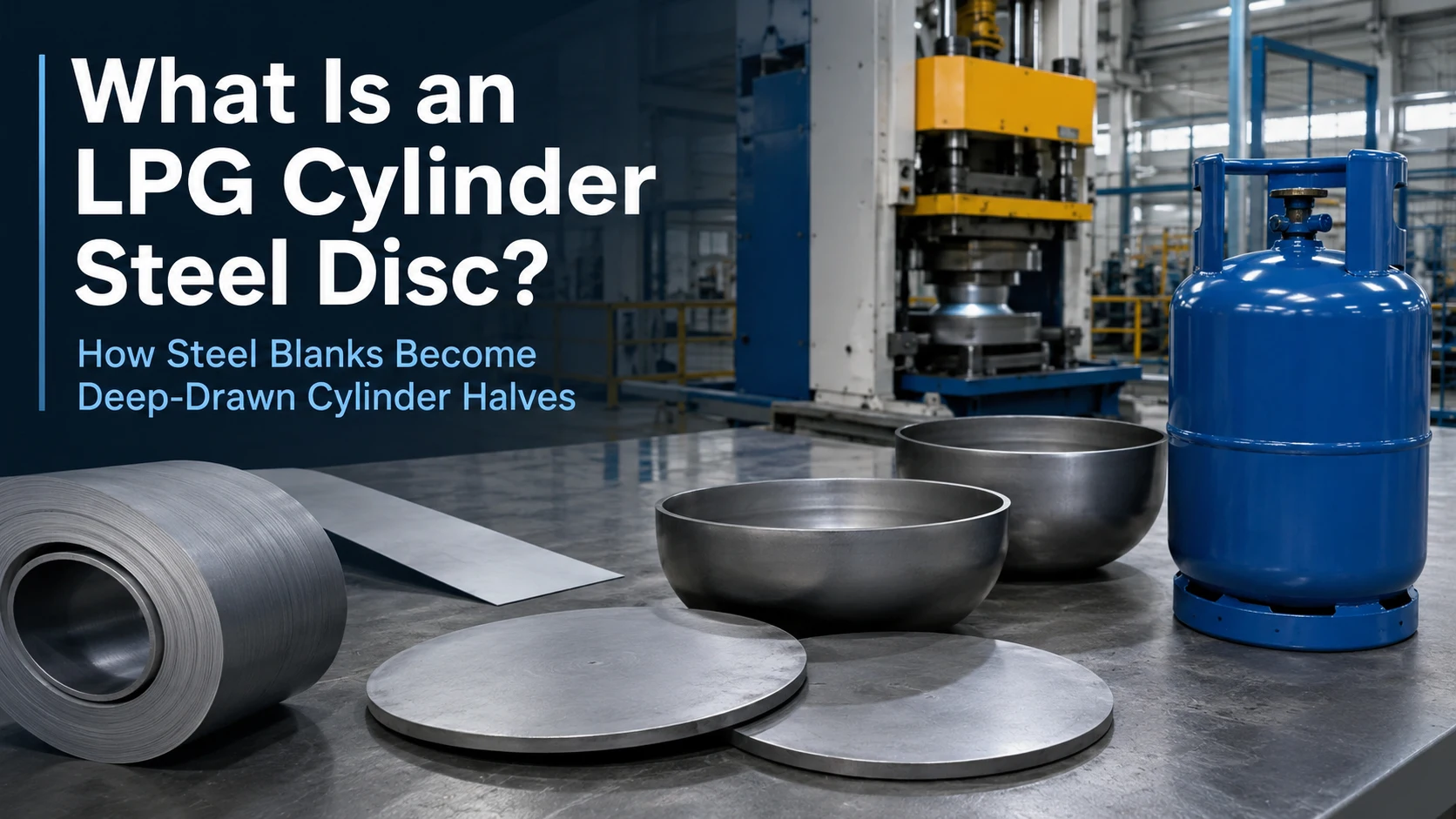
An LPG cylinder steel disc is the circular steel blank used before deep drawing forms the upper or lower half of a welded LPG cylinder. For a B2B buyer, the disc matters for more than understanding how a factory works. Its material, thickness, dimensions, surface condition, and traceability can affect how consistently the shell forms and whether defects such as cracking, wrinkling, excessive thinning, or dimensional variation appear later.
For importers, LPG distributors, engineers, and OEM project managers evaluating a fabricante de cilindros de GLP, the useful question is therefore not simply how a steel disc is cut. It is whether the supplier controls the chain from incoming steel through blanking, deep drawing, shell inspection, and final cylinder verification.
A steel disc, often called a steel blank or circular blank, is a flat round piece of steel prepared for a forming operation. In LPG cylinder manufacturing, that blank is placed into a deep-drawing process that transforms it into a three-dimensional shell half.
The terminology can cause confusion during RFQs and factory audits. A steel coil is continuous rolled feedstock. A sheet is flat material supplied in individual lengths or pieces. A steel disc or blank has already been cut to the circular geometry required for forming. A deep-drawn half is the formed component produced after the blank has passed through the drawing operation.
These terms should not be treated as interchangeable in a technical specification. A buyer who receives a quotation stating only “steel material,” for example, still needs to know the material specification, nominal thickness, actual feedstock arrangement, and how that material remains identifiable during production.
In practice, “steel disc” and “circular steel blank” may describe the same intermediate workpiece, while “coil” and “sheet” describe earlier feedstock forms. The actual starting material may vary by factory, cylinder design, or production arrangement.
This distinction matters when comparing suppliers. If one factory blanks discs internally from coil while another production route starts with prepared discs, the buyer should not assume that their incoming inspection, traceability, or dimensional controls are identical.
The practical procurement question is therefore: what material enters the process, how is it identified, and which specifications are checked before deep drawing begins?
The basic sequence is straightforward: suitable steel stock is prepared, a circular blank is cut, and that blank is inspected before forming. Mintai Cylinder publicly lists “blanking and cutting discs” as the first stage of its LPG cylinder production process, followed directly by deep drawing.
That sequence also shows why blanking should not be treated as an isolated cutting operation. The disc geometry created at this stage becomes the input for the forming process that follows.
Blanking removes a controlled circular piece from steel stock. Depending on the production arrangement, the feedstock may be coil, sheet, or another approved flat-steel format. Buyers should verify the actual route rather than assume every LPG cylinder begins with an identical configuration.
The blank needs to be compatible with the intended cylinder geometry and the qualified forming process. Diameter affects the amount of material available to flow into the die, while thickness and material properties influence how the steel behaves during deformation.
For buyers purchasing finished cylinders, the important questions are not the brand of the blanking machine or its motor power. More useful questions include whether the material matches the approved specification, how blank dimensions are controlled, how batches are identified, and how nonconforming pieces are segregated.
A blank that appears visually acceptable can still create forming problems. Before deep drawing, appropriate production controls may need to address material identity, nominal thickness, blank dimensions, surface condition, edge condition, and traceability.
The exact acceptance limits depend on the cylinder design and applicable specification. They should therefore be verified against approved drawings and production requirements rather than copied from a generic online value.
This is also an important point for supplier audits. Material certificates can support verification, but buyers should ask how material records remain connected to the actual production batch. If cracking or dimensional inconsistency later appears, traceability helps determine whether the problem is linked to a particular steel batch, blanking condition, or forming operation.
During deep drawing, a punch and die form the flat circular blank into a cup-like shell. In an LPG cylinder production route, these formed pieces become the upper and lower body sections that later proceed to operations such as trimming, assembly, and circumferential welding. Mintai’s published production sequence places deep drawing immediately after disc cutting and before trimming and joggling.
The transformation is significant because the steel does not simply bend into shape. Material flows and stretches as it moves through the tooling.
Research specifically examining the deep drawing of LPG bottles identifies sheet thickness and material properties, along with forming variables such as blank-holder force, lubrication, friction, punch and die radii, and tooling clearance, as factors affecting formability. The same research found that forming conditions influence thickness distribution in the drawn component.
For a cylinder buyer, this does not mean specifying machine settings in an RFQ. It means recognizing that a finished-looking shell is the result of interacting material and process variables.
Localized thinning, tearing, or wrinkles can indicate that material flow was not properly controlled. Conversely, changing material or nominal thickness should not automatically be accepted merely because the alternative has a similar commercial description. The proposed material still needs to suit the cylinder design and qualified forming route.
After drawing, inspection should focus on characteristics that affect the next production stages. Visible cracks and severe wrinkles are obvious concerns, but dimensional variation and localized thinning can require measurement rather than visual judgment alone.
Shell geometry is particularly relevant because upper and lower halves eventually need to align correctly for assembly and welding. A repeated problem should therefore trigger more than rejection of individual parts. The supplier should investigate whether the source is the material batch, blank geometry, tooling condition, forming controls, or another documented production factor.
For B2B procurement, steel blank quality is useful only when it is connected to finished-cylinder risk. A technically sound purchasing specification should therefore connect the blank to the approved cylinder design instead of treating it as a generic commodity.
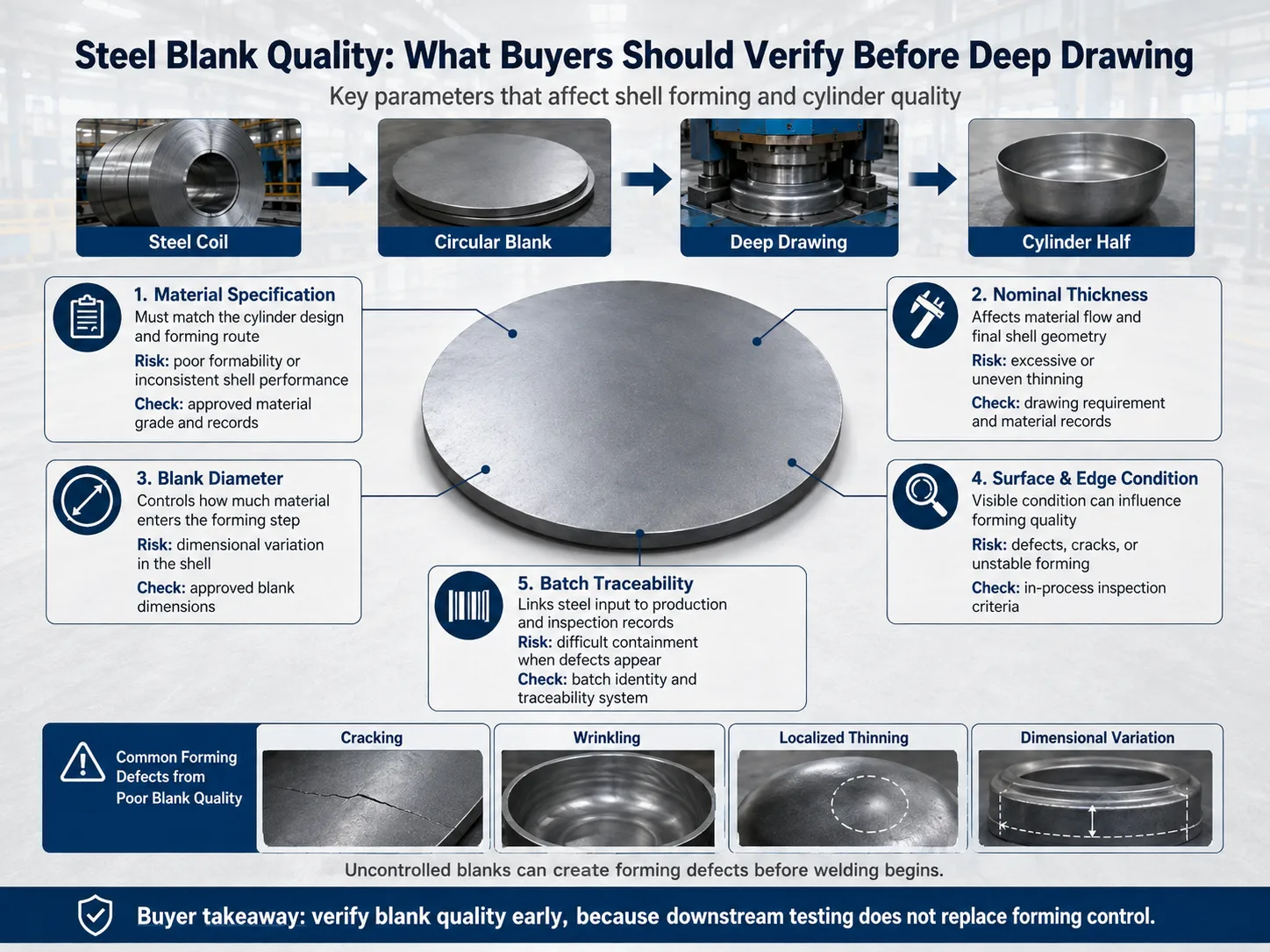
| Factor to verify | Why it matters | Possible risk if uncontrolled | Useful buyer evidence |
|---|---|---|---|
| Material specification | Influences forming behavior and design compatibility | Cracking or inconsistent forming | Approved material specification and records |
| Nominal thickness | Affects deformation and shell geometry | Excessive or uneven thinning | Drawing and material documentation |
| Blank dimensions | Influences material flow and formed geometry | Dimensional variation | Approved blank dimensions |
| Surface and edge condition | Carries into the forming operation | Surface defects or localized damage | In-process inspection criteria |
| Batch identity | Supports investigation and containment | Mixed or untraceable production | Material and batch traceability records |
Material requirements can also vary by product. For example, Mintai’s published 20 kg LPG cylinder specification identifies HP295 and Q235B for that particular product. That is a product-specific reference, not evidence that every LPG cylinder or steel blank uses the same material.
A buyer changing capacity, dimensions, target market, or design should therefore recheck the relevant material and drawing requirements rather than copy specifications from another cylinder model.
Deep-drawing defects are valuable diagnostic signals because they can point back to upstream production conditions. The objective should not be merely to remove a defective shell from the line, but to determine whether other units in the same batch may be affected.
Cracking can be associated with the material’s forming behavior, blank geometry, thickness, lubrication, tooling conditions, or other forming variables. Excessive thinning is less obvious than an open crack but can still indicate that material deformation is not adequately controlled. Research on LPG bottle deep drawing specifically reports uneven thickness distribution and identifies process and friction conditions as influences on thinning.
When repeated cracking or thinning appears, a buyer should expect the supplier to review the affected batch rather than simply replace isolated parts. Material identity, blank records, forming conditions, and inspection results should be considered together.
Preventive control begins upstream: verify the intended steel, maintain the approved blank dimensions, control the qualified forming process, inspect the resulting shells, and preserve records that allow a recurring problem to be traced.
Wrinkling occurs when material flow during drawing becomes unstable. Experimental research on cylindrical cup drawing has shown relationships between blank geometry, sheet thickness, material properties, and wrinkling behavior.
From a purchasing perspective, the important distinction is between an isolated cosmetic irregularity and evidence of an unstable process. Repeated wrinkles, inconsistent shell dimensions, or alignment problems should prompt review of the production batch and forming controls.
A supplier should be able to explain how formed shells are accepted, how nonconforming material is separated, and what happens when the same defect occurs repeatedly. Repair or replacement alone does not demonstrate that the underlying production risk has been removed.
A useful supplier evaluation connects commercial claims to manufacturing evidence. Factory photographs and equipment lists can support an assessment, but they do not replace material records, approved drawings, process controls, inspection evidence, and sample validation.
Mintai Cylinder publicly identifies LPG cylinder research and manufacturing as its core business and provides separate pages for production, inspection, and its LPG cylinder product range. That structure allows buyers to review finished-cylinder configurations alongside the manufacturing and quality-control information relevant to them.
Before production, buyers should define the cylinder capacity and dimensions, target market or applicable requirements, material specification, permitted substitutions, valve and accessory configuration, coating and marking needs, documentation expectations, sample requirements, and intended order quantity.
For the steel blank and forming stages specifically, questions should include:
These questions prevent a common sourcing problem: comparing suppliers on unit price while their underlying specifications are not actually equivalent.
A qualified supplier should be able to connect incoming material, in-process manufacturing, inspection, and final product disposition. The exact record package depends on the project, standard, destination market, and buyer specification.
Final cylinder testing is also separate from blank and forming control. Mintai’s LPG cylinder inspection and testing page describes hydraulic, tightness, bursting, mechanical, X-ray, water-volume, and air-tightness checks among its quality-control activities. These later inspections do not make poor blanking or forming acceptable; they form another layer of verification within the overall manufacturing chain.
For bulk sourcing, buyers should therefore evaluate both ends of the process: how the shell starts and how the finished pressure container is checked.
An LPG cylinder steel disc is a simple-looking component with an important manufacturing role. Material selection, nominal thickness, blank dimensions, surface condition, traceability, and deep-drawing control all influence how consistently the upper and lower cylinder halves can be formed.
The practical purchasing lesson is to evaluate the chain rather than one isolated operation. Buyers reviewing Mintai Cylinder can use the company’s LPG cylinder manufacturing capabilities together with production, product, and inspection information to determine which project-specific details still require written confirmation.
For a new project, a useful next step is to request an LPG cylinder project review with the intended cylinder capacity, dimensions, material or applicable standard, target market, drawings, sample expectations, configuration requirements, and estimated quantity. That information gives the supplier a defined basis for technical review rather than relying on assumptions.
In many manufacturing contexts, yes. “Steel disc” and “circular steel blank” can describe the flat round workpiece prepared for deep drawing. Buyers should still confirm terminology on the supplier’s drawing or process documentation.
Not necessarily. The feedstock may be coil, sheet, or prepared discs depending on the factory, cylinder design, and production arrangement. The actual source material and traceability method should be confirmed with the manufacturer.
No universal disc specification should be assumed. Blank diameter, nominal thickness, material, and forming requirements depend on the cylinder design and applicable product specification.
Possible contributors include material formability, thickness, blank geometry, friction, lubrication, tooling conditions, and forming parameters. Repeated cracking should trigger batch containment and review of both material and process records rather than isolated replacement.
Buyers should confirm material identity, dimensional conformity, the absence of unacceptable forming defects, applicable shell inspection results, and traceability to the relevant material and production batch.