
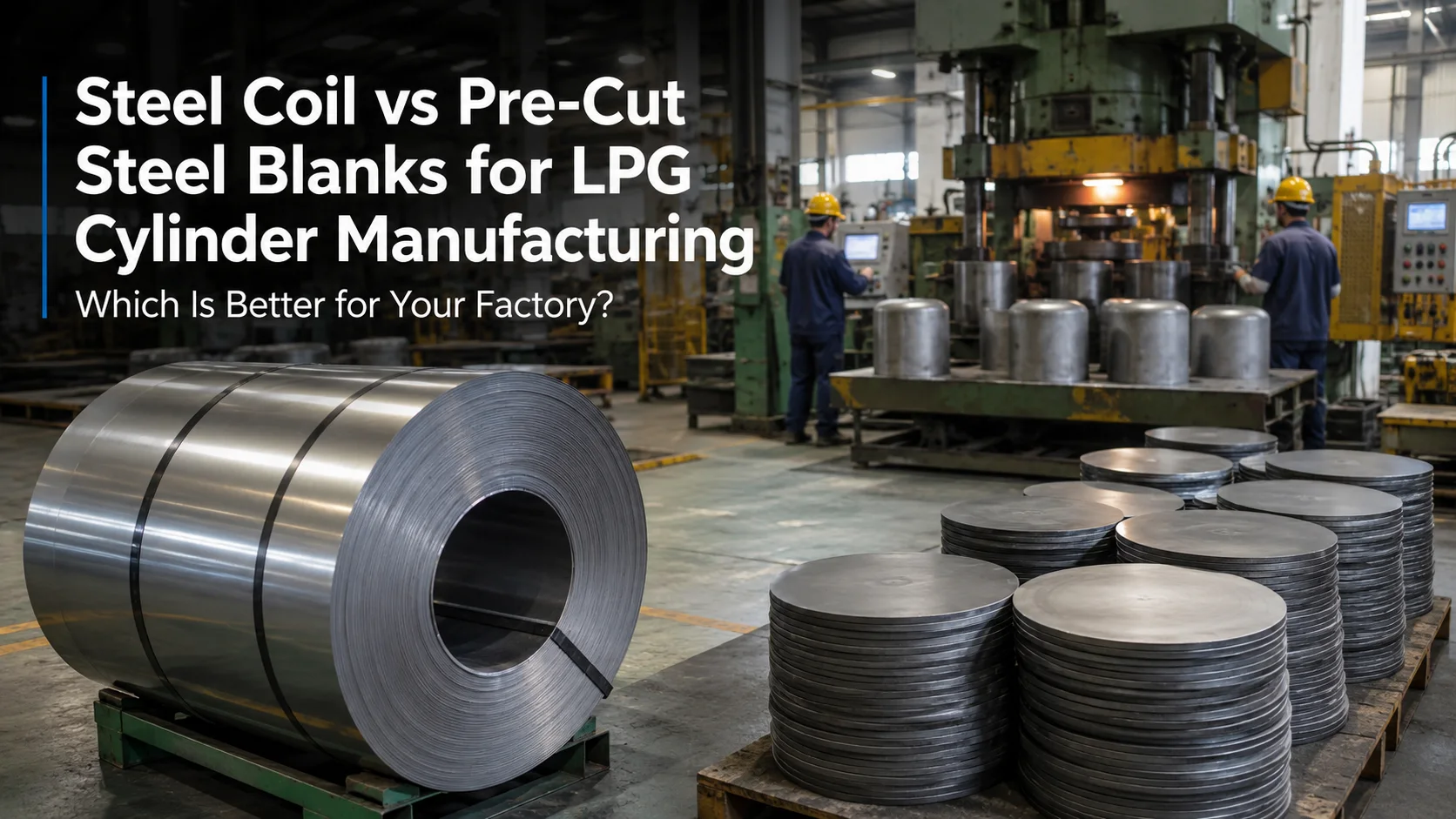
LPG cylinder manufacturers can buy steel coil and blank circular discs in-house, or purchase pre-cut steel blanks from a qualified supplier. Neither route is automatically cheaper. The choice depends on production volume, equipment, scrap, labor, quality control, and supplier reliability. When comparing steel coil vs pre-cut steel blanks for LPG cylinder manufacturing, the useful metric is not simply price per ton or price per disc, but the total cost and risk of getting an accepted blank into deep drawing.
The main difference is who performs and controls blanking. With steel coil, the cylinder factory handles coil preparation, blanking, tooling, scrap, and dimensional inspection. With pre-cut LPG cylinder steel blanks, the supplier performs the cutting step and the factory receives circular discs for forming, still subject to incoming inspection.
Mintai’s published LPG cylinder production process places blanking and cutting discs before deep drawing and trimming, showing why blank quality matters to the next stage.
| Decision Factor | Steel Coil + In-House Blanking | Pre-Cut Steel Blanks |
|---|---|---|
| Blanking responsibility | Factory | Supplier |
| Front-end equipment | Required | Reduced |
| Tooling and maintenance | Internal | Mainly supplier-side |
| Scrap control | Factory | Reflected in supplier processing |
| Incoming QC | Coil-focused | Blank-focused |
| Flexibility | Depends on tooling/capacity | Depends on supplier capability |
| Main supply risk | Coil availability | Blank consistency and lead time |
Steel coil is worth evaluating when a factory already has blanking equipment, tooling capability, and stable demand. It can also suit manufacturers seeking direct control over material purchasing and blank dimensions.
An existing blanking line changes the economics because much of the equipment burden is already in place. For a factory without suitable equipment or with irregular output, coil handling, dies, maintenance, labor, and inspection may create a high fixed burden.
Before deciding, managers should review annual demand by diameter, line utilization, changeovers, maintenance capacity, and whether blanking is already a bottleneck. A break-even point should be calculated from actual factory data rather than a generic production-volume rule.
A lower price per ton of coil does not automatically create a lower cost per usable blank. Offcuts, rejects, tooling wear, machine time, labor, and handling also matter.
A better comparison is total steel and processing cost divided by accepted blanks released to deep drawing. In-house blanking can provide more direct process control, but that advantage only has value when the factory can manage yield, dimensions, tooling, and material identification consistently.
Pre-cut blanks can reduce upstream processing when a cylinder producer lacks blanking equipment, needs additional capacity, or handles several blank diameters without wanting to maintain every cutting tool internally.
Factories without a blanking line can buy ready-cut circular blanks and focus resources on forming and downstream operations. The same approach may help when existing blanking capacity is overloaded, a new cylinder size is being introduced, or production is too variable to keep dedicated equipment busy.
However, “pre-cut” does not mean “inspection-free.” Before deep drawing, the factory should verify material, thickness, diameter, surface condition, and edge condition against the approved specification. If these requirements are wrong, outsourcing simply moves the defect upstream.
Purchased blanks can simplify size changes, but increase dependence on supplier capacity, lead time, and batch consistency. A delayed blank shipment can stop forming production just as effectively as an internal equipment failure.
Buyers should compare lead time, safety-stock needs, batch repeatability, and whether a second qualified source is needed. Mixed sourcing can also work: coil may support stable high-volume sizes, while pre-cut blanks cover new models, overflow demand, or less frequent diameters.
The correct comparison is total landed and processing cost. For the coil route, include steel, freight, equipment depreciation, tooling, labor, maintenance, scrap, handling, inventory, and inspection. For purchased blanks, include unit price, processing premium, packaging, freight, incoming inspection, rejected material, and safety stock.
Capacity also has a cost. If blanking limits deep drawing output, outsourcing part of the demand may be worthwhile even at a higher unit price. Conversely, a well-utilized internal line may make outsourced processing unnecessary. Compare cost per accepted blank and the effect on overall production flow.
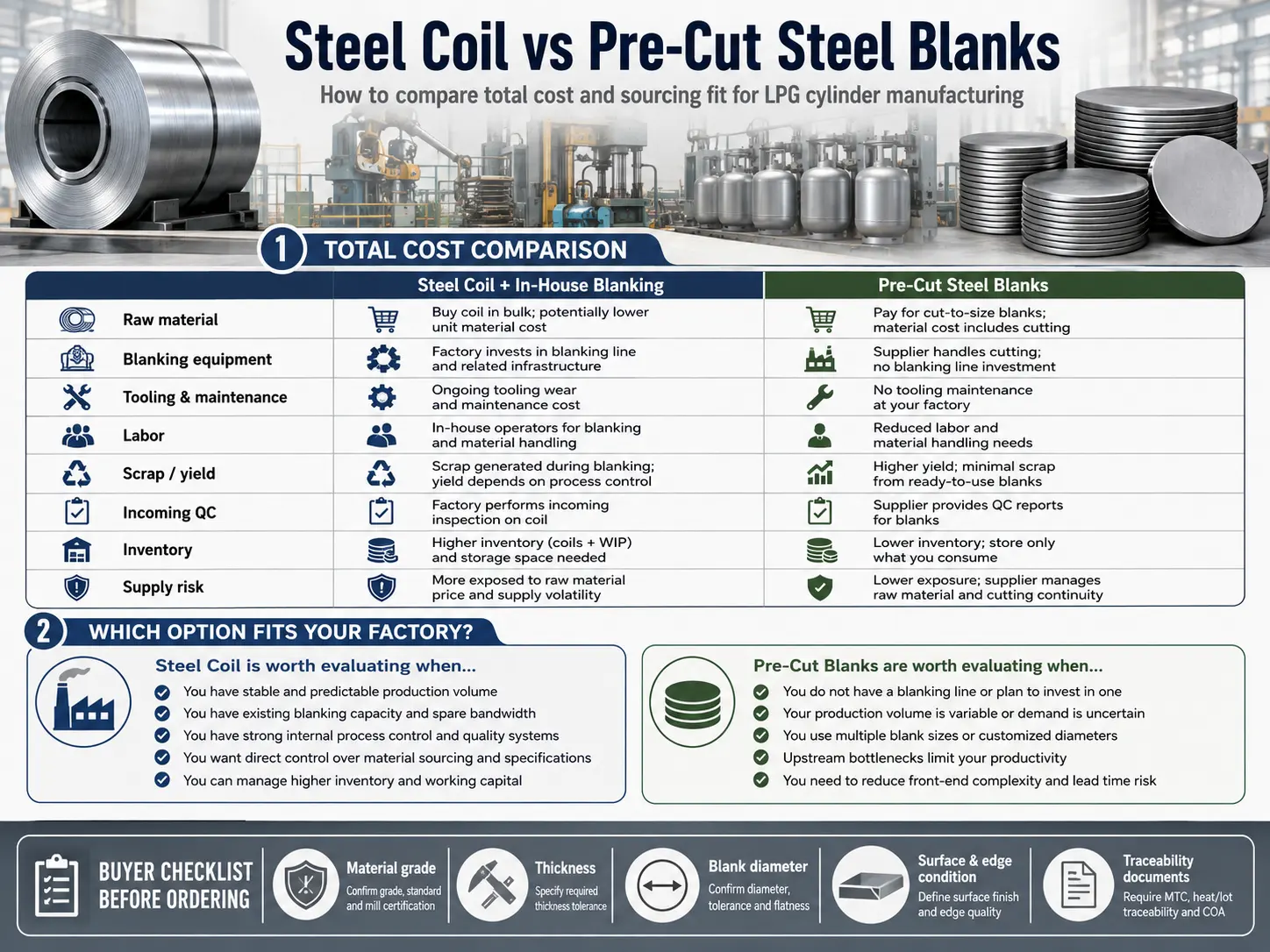
Circular blanks are not generic cut-steel parts. Their characteristics must match the cylinder design and forming process. Mintai’s published quality-control content highlights steel thickness and surface condition, material certificate review, batch traceability, cutting accuracy before forming, and visual inspection for rust or scratches.
These items should be confirmed against the approved drawing or product specification. Material grade affects forming behavior and downstream requirements; thickness must meet the applicable specification; and blank diameter must match the forming design.
An oversized or undersized blank should not be treated as a minor issue that trimming will automatically correct. Starting dimensions affect material flow and downstream fit. An RFQ should state the material specification, nominal thickness, blank diameter, drawing revision, quantity, and agreed inspection requirements. This is where material quality and traceability become part of the purchasing decision.
Scratches, corrosion, damaged edges, contamination, or inconsistent cutting can create forming problems or leave defects that become harder to manage later.
Incoming inspection and trial forming can help determine whether blanks from the same lot behave consistently. For repeat orders, batch-to-batch repeatability matters more than one good sample. Packaging and handling requirements should also protect the blank surface during storage and transport.
Key risks include specification mismatch, wrong material, damaged edges, inconsistent batches, and delivery delays.
Use an approved drawing revision for each size, define material and document requirements, identify lots clearly, inspect incoming blanks, and agree how nonconforming batches will be handled. For a new supplier or diameter, a sample or trial batch can confirm deep-drawing suitability before a full order is released.
A supplier should be judged on its ability to support repeatable cylinder forming, not only on cutting capacity or unit price.
Mintai Cylinder manufactures LPG cylinders and lists six automated production lines on its official site. Its production sequence begins with blanking and disc cutting followed by deep drawing. Buyers can review its LPG cylinder manufacturing capabilities when assessing whether a source understands how blanks perform in downstream cylinder manufacturing.
The supplier should work from a controlled drawing or specification and explain how material identity, dimensions, and batch consistency are checked. Buyers should confirm which material certificates, inspection records, and traceability documents are required and available before ordering.
Mintai Cylinder can supply steel coil and pre-cut circular blanks within its confirmed semi-finished product scope. Reviewing its fabricante de cilindros de GLP background can provide useful context, but the specific blank still needs to be qualified against the buyer’s drawing and forming requirements.
A useful RFQ should include the cylinder model or application, drawing and revision, material grade or specification, blank diameter, thickness, quantity per size, expected annual demand, surface and edge requirements, required documents, packaging, and destination.
For a replacement source, provide a controlled drawing or approved sample rather than relying only on nominal diameter.
Steel coil is generally worth evaluating when blanking equipment already exists, utilization is stable, volumes are predictable, and the factory can manage tooling, scrap, and QC. Pre-cut blanks deserve stronger consideration when equipment is unavailable or overloaded, output varies by size, new models are being introduced, or management wants to reduce upstream complexity.
There is no universal winner. Mixed sourcing can also suit factories using coil for stable programs and pre-cut blanks for variable or overflow demand.
The steel coil vs pre-cut steel blanks decision should be treated as a manufacturing and sourcing decision, not a raw-material price comparison. Calculate cost per accepted blank, consider the effect on line capacity, and qualify material, dimensions, surface condition, and traceability before approving a source.
For a specific LPG cylinder project, Mintai Cylinder can review steel coil or pre-cut blank requirements. Buyers can request a technical quotation by providing the drawing, material specification, blank diameter, thickness, quantity, documentation requirements, packaging needs, and destination.
They can be used as the forming input when material, thickness, diameter, surface, edge condition, and other specified requirements have been verified. Incoming inspection is still needed.
Not necessarily. Compare total cost per accepted blank, including equipment, tooling, labor, energy, scrap, maintenance, freight, inventory, and inspection.
Provide the drawing, material specification, blank diameter, thickness, quantity, surface or edge requirements, required documents, packaging, and destination.
Variation in material, thickness, dimensions, or edge condition can affect forming consistency. Blanks should be qualified against the forming specification.
Consider outsourcing when blanking equipment is unavailable or overloaded, production varies by size, or the factory wants less upstream processing. Supplier consistency still needs control.