
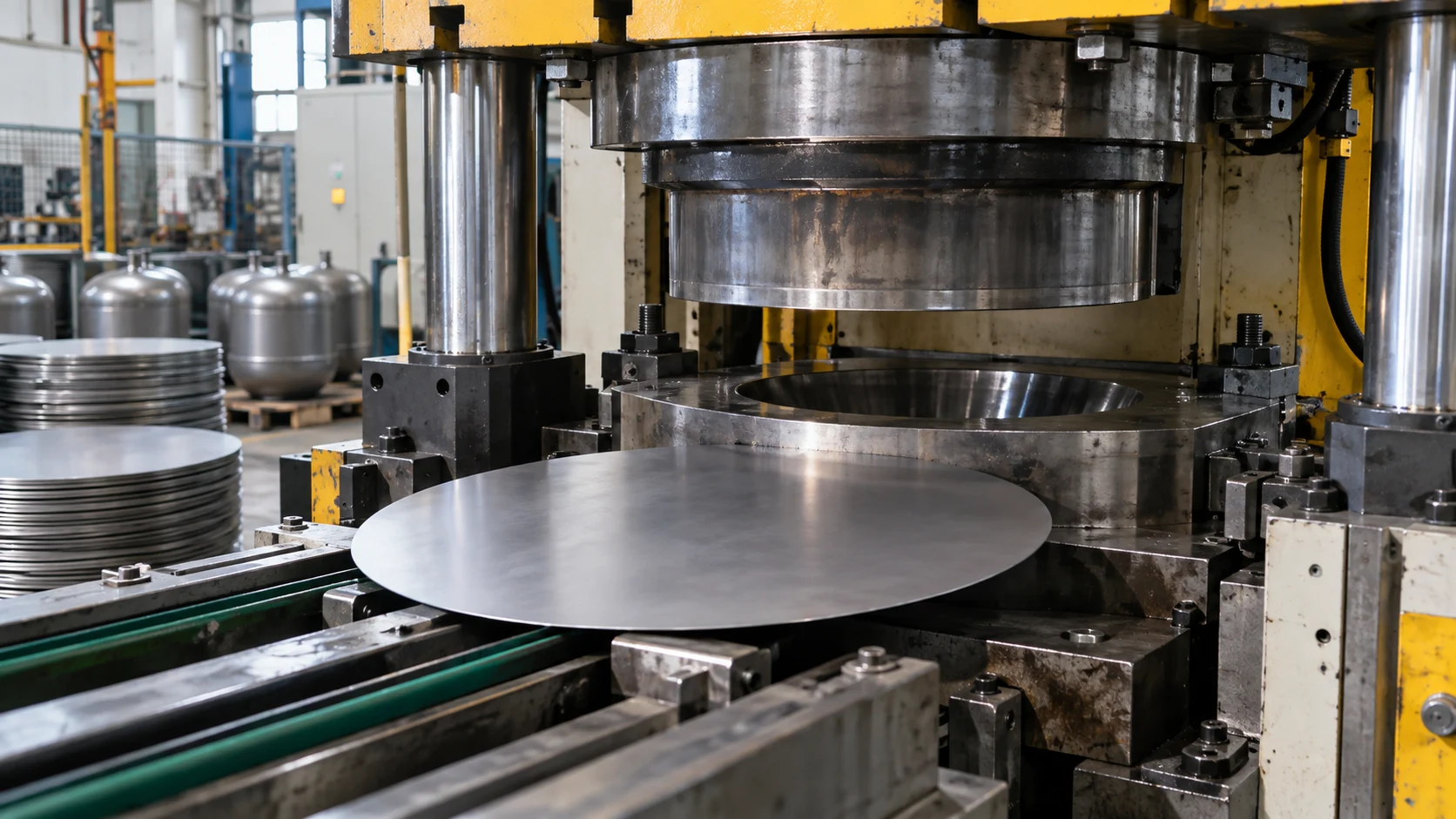
A good steel blank for LPG cylinder deep drawing is not simply a round piece of metal with the right nominal size. It must combine a verified material specification, consistent thickness, controlled diameter, clean edges, sound surface condition, and traceability to the cylinder design and forming route. Those characteristics help the blank flow through the die without avoidable cracking, wrinkling, thinning, or dimensional drift. For a buyer, the practical test is whether the supplier can prove that the blank is controlled before forming and that the resulting shell remains consistent afterward.
Material selection begins with the approved cylinder design, applicable market requirements, and qualified deep-drawing process. A grade name alone is not enough because two materials with similar commercial descriptions can behave differently during deformation. The blank has to suit the intended diameter, wall geometry, welding route, and downstream inspection plan.
The RFQ should identify the material standard or approved grade, nominal thickness, permitted substitutions, and the documents required with each batch. Thickness matters because it influences the amount of deformation available during drawing and the final shell geometry. Actual acceptance limits should come from the approved drawing or specification, not from a generic online value.
Chemical and mechanical properties affect formability, but their relevance depends on the complete cylinder design. A material that works for one capacity or shell geometry may not be transferable to another without validation. Mintai Cylinder product information illustrates why product-specific review matters: a material reference shown for one cylinder model should not be treated as a universal specification for every LPG cylinder. Ask the supplier to confirm the material against the selected model, drawing, and destination requirements.
Deep drawing converts a flat circular blank into a three-dimensional shell by moving material through a punch, die, and blank-holder system. The blank therefore enters the process with a geometry that directly affects material flow. Small, repeated variations can become large differences in shell height, wall distribution, or rim alignment after forming.
Blank diameter should be controlled against the approved drawing, with a measurement method and sampling plan that the buyer can understand. A blank that is undersized may not provide enough material for the intended profile; an oversized blank can increase wrinkling or trimming demand. Thickness should be checked at defined locations, and the results should be linked to the material batch. Consistency between blanks is usually more valuable than a single passing measurement because production stability depends on repeatability.
The circular edge should be free from burrs, severe notches, tears, and damage that could become a crack initiator during drawing. The flat surface should also be checked for deep scratches, scale, corrosion, dents, or contamination that could interfere with forming or later coating. The correct inspection limit depends on the process, so the buyer should request the supplier’s acceptance criteria and examples of rejected blanks rather than rely on the phrase “good surface.”
A pre-production review should connect documents, measurements, and a forming sample. The purpose is not to create paperwork for its own sake; it is to establish that the incoming blank, the tooling, and the intended cylinder geometry are compatible before a bulk order is released.
A visually clean blank can still be unsuitable if its properties or dimensions cause unstable forming. The most useful acceptance decision connects blank records to the behavior of the formed half. This is why a supplier audit should cover both incoming material controls and the inspection performed after drawing.
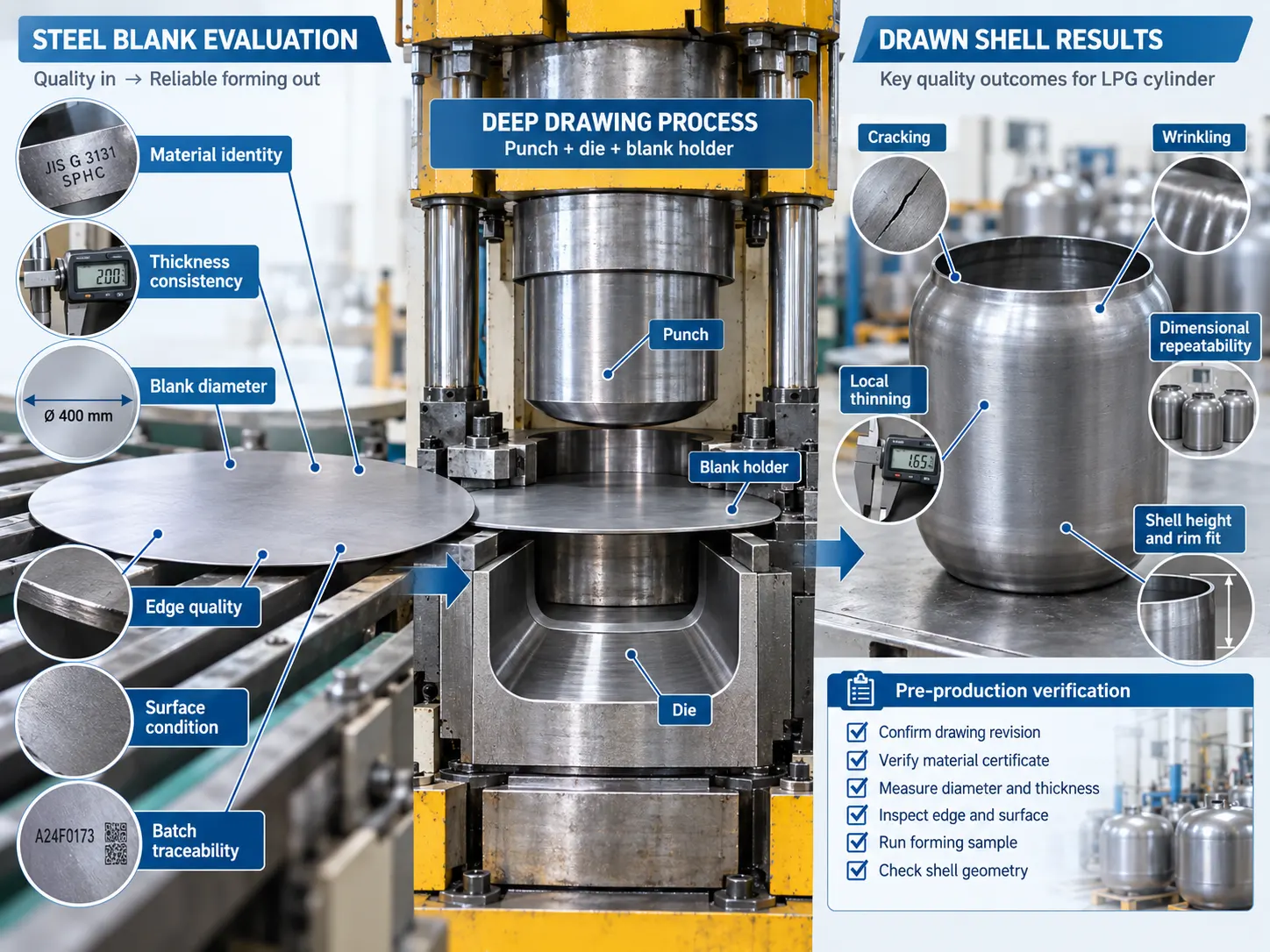
Cracks can be associated with material formability, thickness variation, edge damage, lubrication, tooling condition, or other forming parameters. Localized thinning may not be visible, yet it can signal that material flow is concentrating in one area. Wrinkling usually points to unstable flow or insufficient control of the forming conditions. None of these symptoms identifies one cause by itself. Repeated defects should trigger a review of the material batch, blank geometry, tooling, lubrication, and process records rather than isolated replacement of defective shells.
The upper and lower shell halves must remain compatible with trimming, edge preparation, and circumferential welding. Buyers should therefore ask how shell height, diameter, rim condition, and other critical dimensions are checked. A supplier that only reports “visual inspection passed” has not yet demonstrated control of repeatability. The evidence may be a first-article report, inspection record, sample measurement set, or another format agreed for the project.
The strongest steel blank specification is short enough to use in an RFQ but specific enough to prevent unequal quotations. Include the cylinder capacity and drawing reference, material and thickness, blank dimensions and tolerances, surface and edge requirements, batch identification, sample expectations, inspection records, and the process for approving substitutions. Also state the target market or applicable standard when it changes the design or documentation needed.
During supplier evaluation, review how the manufacturer connects incoming steel to blanking, deep drawing, trimming, welding, and final testing. Mintai Cylinder presents separate information for its production controls, inspection activities, and finished LPG cylinder products. That structure can help a buyer identify which project-specific records still need written confirmation.
Mintai Cylinder identifies LPG cylinder research and manufacturing as its core business and supports OEM-oriented discussions. For a buyer assessing deep-drawn shell inputs, the relevant question is not whether a supplier can show a factory or a finished cylinder. It is whether the supplier will review the selected capacity, dimensions, material, forming route, inspection plan, and documentation as one connected package. A related explanation of steel discs and circular blanks can provide process context, while a new project should still be checked against its own drawing and requirements.
A good steel blank for LPG cylinder deep drawing is compatible, consistent, traceable, and proven in the intended forming route. Material identity and thickness establish the starting point; diameter, edge quality, and surface condition control how the blank enters the die; and sample forming plus shell inspection show whether the specification works in practice. Buyers should evaluate those links together instead of approving a blank on size or appearance alone.
In many LPG cylinder manufacturing contexts, “steel blank” and “steel disc” describe the same flat circular workpiece prepared for deep drawing. Confirm the terminology on the supplier’s drawing and process documents.
There is no universal thickness for every cylinder. It depends on the design, material specification, forming route, applicable requirements, and validation evidence for the selected model.
Check material identity, thickness, diameter, flatness, edge condition, surface condition, and batch traceability. Then confirm the result with a representative forming sample and shell inspection.
Only after the substitution is technically reviewed and approved against the cylinder design, forming process, welding requirements, and destination-market documentation. Similar naming does not prove equivalent behavior.
For a project-specific fit check, اتصل بالفريق التقني with the cylinder capacity, dimensions, material or applicable standard, drawing revision, target market, sample expectations, configuration, and estimated quantity.