
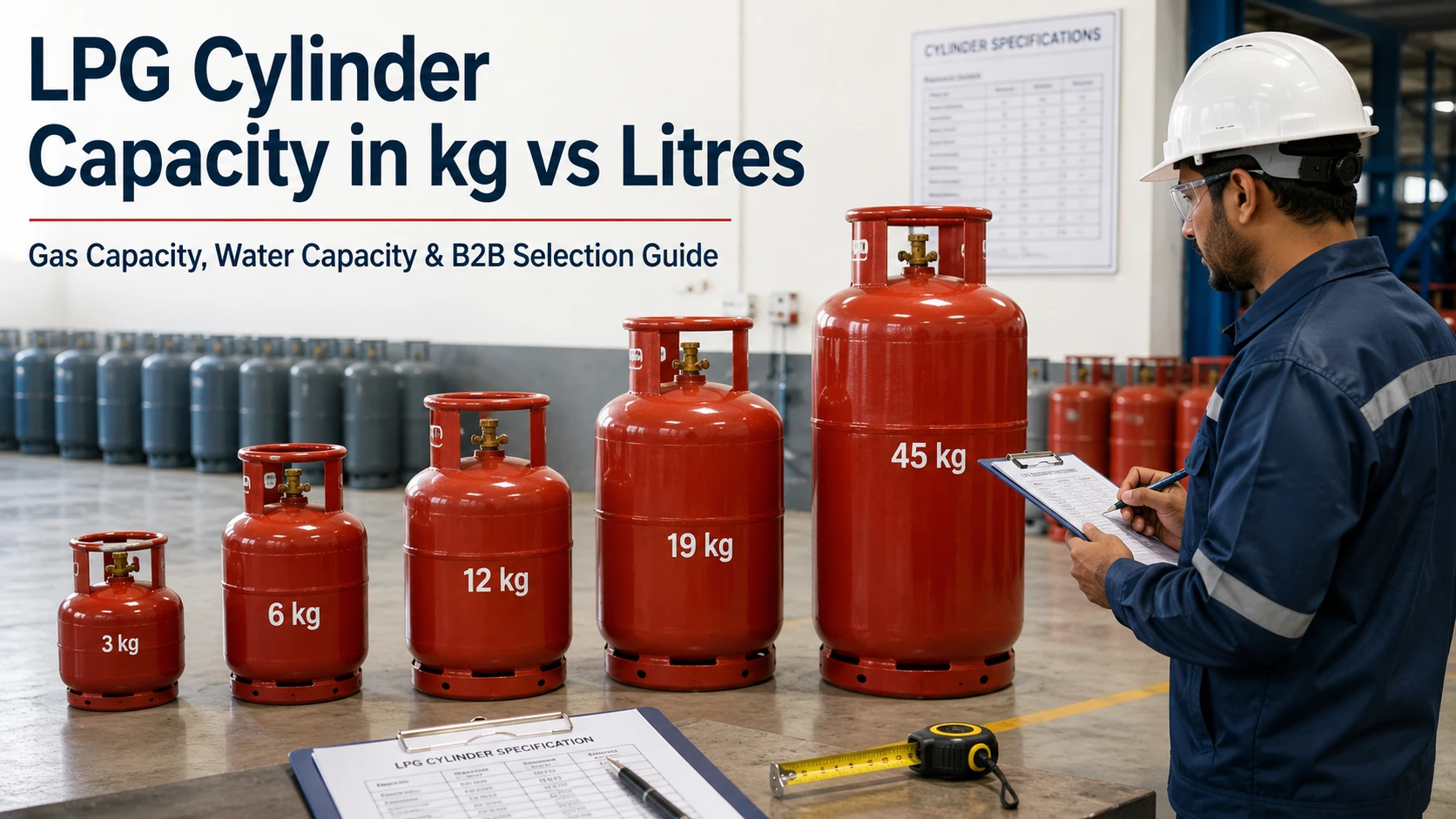
When an LPG cylinder is described as 9kg, 20kg, 45kg, 47.7L, or 108L, those numbers do not necessarily describe the same type of capacity. For B2B buyers, confusing LPG cylinder capacity in kilograms with water capacity in litres can lead to incorrect comparisons, unsuitable replacements, and incomplete RFQs.
In most product specifications, kilograms describe the nominal LPG filling mass, while litres may refer to the cylinder’s internal water capacity or, in a different context, the calculated volume of liquid LPG. Understanding that distinction is essential before comparing cylinders from different suppliers or selecting a model for a particular market.
An LPG cylinder specification may contain several capacity-related figures, each serving a different purpose.
A cylinder identified as “45kg,” for example, is normally classified by its nominal LPG filling mass. A separate specification such as “108L water capacity” describes the internal volume of the cylinder measured by water volume. It does not mean that the cylinder should simply be filled with 108 litres of LPG.
This distinction matters to importers, distributors, equipment buyers, and replacement teams because quotations may use different terminology. One supplier may lead with gas capacity in kilograms, while another may emphasize water capacity in litres.
Gas capacity is useful when confirming the nominal cylinder size required by a distribution program, application, or target market. Water capacity is useful when comparing the cylinder body and its internal volume against a technical specification.
Liquid LPG volume is a third concept. It describes the actual volume occupied by LPG in liquid form and may be calculated from mass when the correct liquid density is known.
For procurement purposes, these figures should not be treated as interchangeable. A buyer replacing an existing cylinder should confirm both the nominal gas capacity and water capacity, then check any other required dimensions, valve configuration, and market-specific requirements against the product specification.
A search for “LPG kg to litres” often starts with a simple question: if a cylinder contains a certain mass of LPG, how many litres of liquid LPG does that represent?
The basic relationship is:
Liquid LPG volume = LPG mass ÷ liquid LPG density
The calculation itself is straightforward. The difficulty is choosing the correct density. LPG may contain propane, butane, and related hydrocarbons, and its physical properties vary with composition and conditions. OSHA, for example, identifies commercial LPG as a mixture that may contain C3 and C4 hydrocarbons rather than one single fixed substance.
For that reason, a kg-to-litre calculation should use density data appropriate to the actual LPG specification and operating conditions. It should not be converted into a universal rule for choosing a cylinder.
A mass-to-volume calculation can be useful for fuel accounting, logistics planning, inventory estimates, or checking a known LPG specification. In those cases, the buyer already knows what liquid is being considered and can use an appropriate density value.
It becomes misleading when the calculated liquid LPG volume is treated as the cylinder’s water capacity.
For example, a calculation showing that a certain mass of LPG occupies a particular liquid volume does not prove that a cylinder with the same litre rating is suitable. Cylinder selection still depends on the actual cylinder specification.
This distinction is especially important in international procurement. If a quotation lists only “20kg LPG cylinder,” request the corresponding water capacity and technical datasheet rather than assuming a fixed litre value.
Water capacity describes the internal cylinder volume, while the permitted or specified LPG filling mass depends on additional factors. LPG composition is one of them because propane-rich and butane-rich mixtures do not have identical physical properties. Applicable filling requirements and cylinder specifications may also vary by market.
This is why procurement teams should avoid building a purchasing specification around a single universal kg-to-litre ratio.
If two suppliers offer cylinders with similar water capacities but different nominal filling masses, the difference should be investigated rather than automatically treated as an error. Ask which LPG specification, market requirement, and cylinder design the quoted filling capacity relates to.
The next step is to compare the supplier’s datasheet with the intended application and destination-market requirements.
A product-based capacity chart is more useful for purchasing than a generic conversion table because it compares actual cylinder specifications rather than theoretical kg-to-litre calculations.
Mintai’s available LPG cylinder range includes several nominal capacities for different product requirements. The published specifications currently include the following examples:
| LPG Cylinder Model | Nominal Gas Capacity | ความจุน้ำ | Procurement Use |
|---|---|---|---|
| 6kg cylinder | 6kg | 14.4 ลิตร | Compare compact-cylinder specifications |
| 9kg cylinder | 9kg | 21.6L | Confirm distributor or replacement requirements |
| 12.5kg cylinder | 12.5kg | 26.5 ลิตร | Compare medium-capacity cylinder specifications |
| 20kg cylinder | 20kg | 47.7 ลิตร | Check commercial or replacement requirements |
| 45kg / 100lb cylinder | 45kg | 108 ลิตร | Compare higher-capacity commercial specifications |
These values are published product specifications, not universal LPG conversion ratios. Mintai’s individual product pages list 14.4L for the 6kg model, 21.6L for the 9kg model, 26.5L for the 12.5kg model, 47.7L for the 20kg model, and 108L for the 45kg model.
The 45kg example is particularly useful because it explains a common search question. A 45kg LPG cylinder with 108L water capacity can legitimately carry both figures: 45kg identifies the nominal LPG capacity, while 108L identifies internal water capacity.
Understanding the numbers is only the first stage. A purchasing decision must establish whether the proposed cylinder actually matches the intended market, refill system, equipment, and distribution model.
When replacing an existing LPG cylinder, start with the data plate, approved specification, drawing, or existing supplier datasheet where available.
Do not assume that two cylinders carrying the same nominal kg label are automatically interchangeable. Compare gas capacity and water capacity first. Then verify dimensions, valve requirements, and any other specifications that affect connection, storage, handling, filling, or local acceptance.
If the existing product information is incomplete, the safest purchasing approach is to document the known specification and ask prospective suppliers to identify any differences explicitly.
A replacement decision based only on price and nominal kg capacity increases the risk of receiving a cylinder that does not match existing cages, filling infrastructure, regulators, or distribution practices.
For a new distribution program, capacity should be selected from the application backward rather than from a supplier catalog forward.
First define the target market and required nominal filling capacity. Then confirm the water capacity and the LPG specification associated with that requirement. Buyers should also establish how the cylinder will be transported, refilled, stored, and connected before finalizing the model.
Capacity alone does not answer every selection question. Buyers who still need to compare nominal cylinder sizes, refill frequency, and application demand can review the guide to choosing the right LPG cylinder size rather than duplicating those decisions inside a capacity specification.
For a formal RFQ, the selected capacity should therefore become one part of a broader technical requirement, not the entire requirement.
Most capacity errors come from terminology rather than complicated engineering.
The first mistake is treating water capacity as the amount of LPG that should be filled into the cylinder. A 108L water-capacity figure describes internal cylinder volume; it should not be read as a simple instruction to fill 108 litres of LPG.
The second mistake is applying one kg-to-litre ratio to every LPG market. Because LPG composition and density can vary, conversion assumptions should be checked against the relevant LPG specification rather than copied from a generic calculator.
The third mistake is comparing suppliers only by nominal kilogram rating. Two quotations for “45kg cylinders” should still be checked for water capacity, dimensions, valve configuration, materials where relevant, and applicable technical requirements.
These problems can usually be prevented by requesting a complete datasheet before comparing quotations and by separating “gas capacity,” “water capacity,” and “liquid LPG volume” in internal purchasing documents.
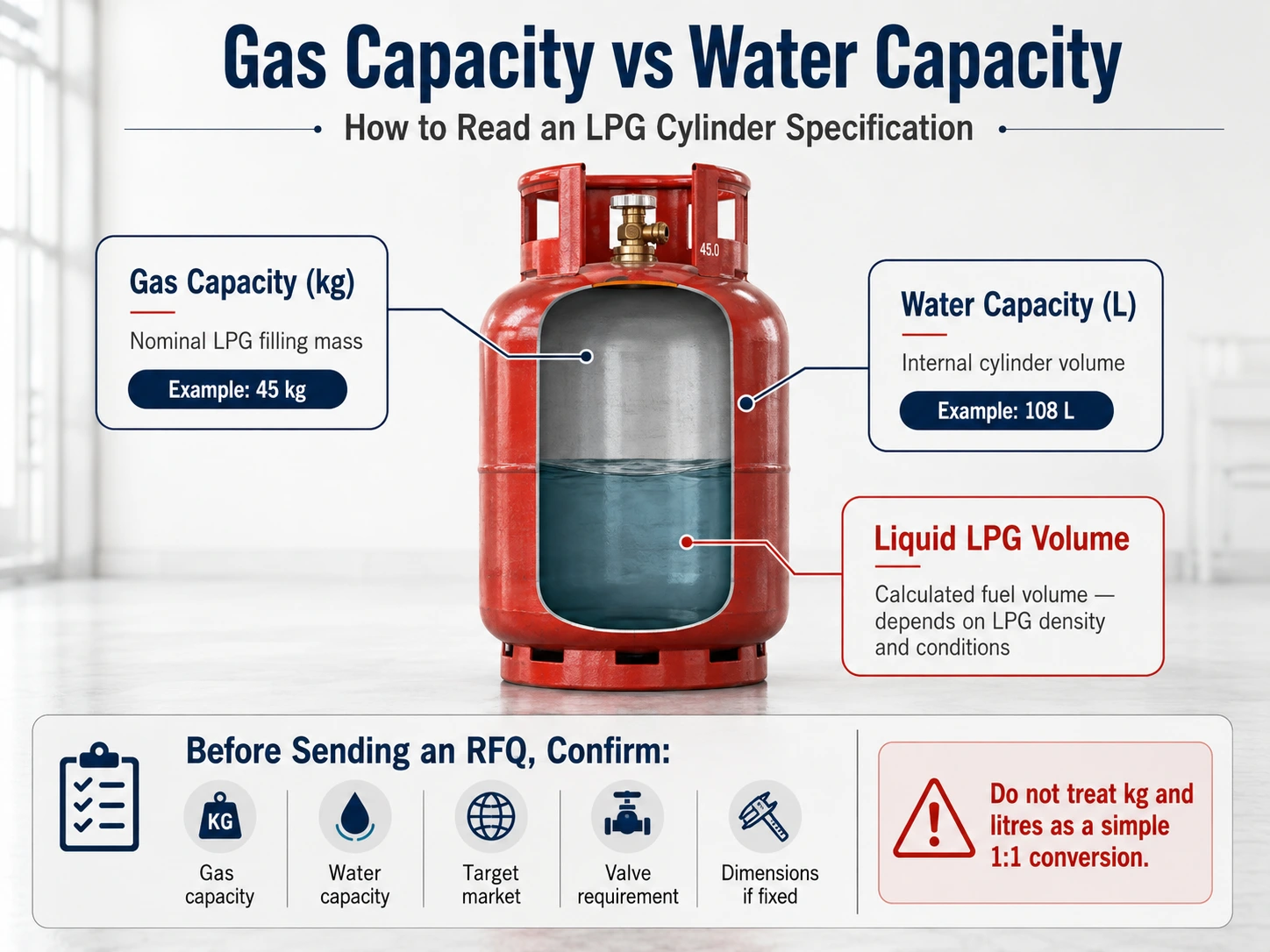
A clear RFQ reduces specification ambiguity and makes supplier quotations easier to compare.
At minimum, provide or request confirmation of:
If some values are not yet known, identify them as open items rather than filling the RFQ with assumed figures.
เดอะ กระบอกมินไท product portfolio currently includes exported LPG cylinder models from smaller portable capacities through 45kg/100lb products, allowing buyers to compare actual specifications before discussing a bulk order. The exported-cylinder category currently lists models including 6kg, 9kg, 12.5kg, 20kg, and 45kg/100lb cylinders.
Once the required capacity is established, supplier evaluation should focus on whether the manufacturer can translate the buyer’s requirements into a consistent, documented product specification.
A supplier should be able to state clearly what the nominal kg figure represents and provide the corresponding water capacity. Product descriptions, drawings, datasheets, and quotations should not contain unexplained capacity conflicts.
For B2B purchasing, it is also useful to confirm whether the supplier can discuss requirements for different cylinder sizes, support OEM specifications when needed, and provide relevant product information for technical review before production.
Mintai Cylinder states that it specializes in LPG cylinder research and manufacturing, operates six automated production lines, supports OEM orders, and has cylinder testing equipment. These published capabilities are relevant when buyers need specification confirmation rather than only a nominal product name.
Capacity is still only one part of supplier qualification. Applicable standards, valve configuration, material specifications, documentation, and destination-market requirements should be verified for the actual order rather than assumed from a general product category.
LPG cylinder capacity in kg and litres should not be treated as a simple one-to-one conversion. Kilograms usually identify nominal LPG filling mass, water capacity describes the cylinder’s internal volume, and calculated liquid LPG litres represent a separate fuel-volume measurement.
For B2B buyers, the practical solution is to compare actual cylinder specifications instead of relying on a generic kg-to-litre ratio. Confirm gas capacity, water capacity, target market, LPG requirements, valve configuration, dimensions where necessary, and applicable technical requirements before placing an order.
Buyers preparing a replacement program, distributor order, or new cylinder specification can ติดต่อ Mintai Cylinder with the required capacity, destination market, quantity, existing datasheet or drawing, and any known valve or dimensional requirements. This gives the supplier enough information to discuss a suitable specification without relying on assumptions.
Both measurements may appear in an LPG cylinder specification, but they describe different things. Kilograms normally describe nominal LPG filling mass, while litres commonly describe water capacity. Buyers should confirm exactly what each number means before comparing products.
There is no single answer unless “litres” is defined. Liquid LPG volume depends on the LPG density used in the calculation. A specific 45kg cylinder may also have a separate water-capacity figure. For example, Mintai’s published 45kg cylinder specification lists 108L water capacity.
The two figures can describe different specifications of the same cylinder. In Mintai’s 45kg model, 45kg is the nominal LPG capacity and 108L is the published water capacity. They are not the result of directly converting 45kg into 108 litres.
Water capacity is the internal volume of the cylinder expressed as the volume of water it can contain. It is a technical cylinder specification and should not be interpreted as the permitted LPG filling volume.
Not by itself. A mass-to-volume calculation can help estimate liquid LPG volume when the correct density is known, but cylinder selection should use the actual product specification, including nominal gas capacity, water capacity, and other application or market requirements.