
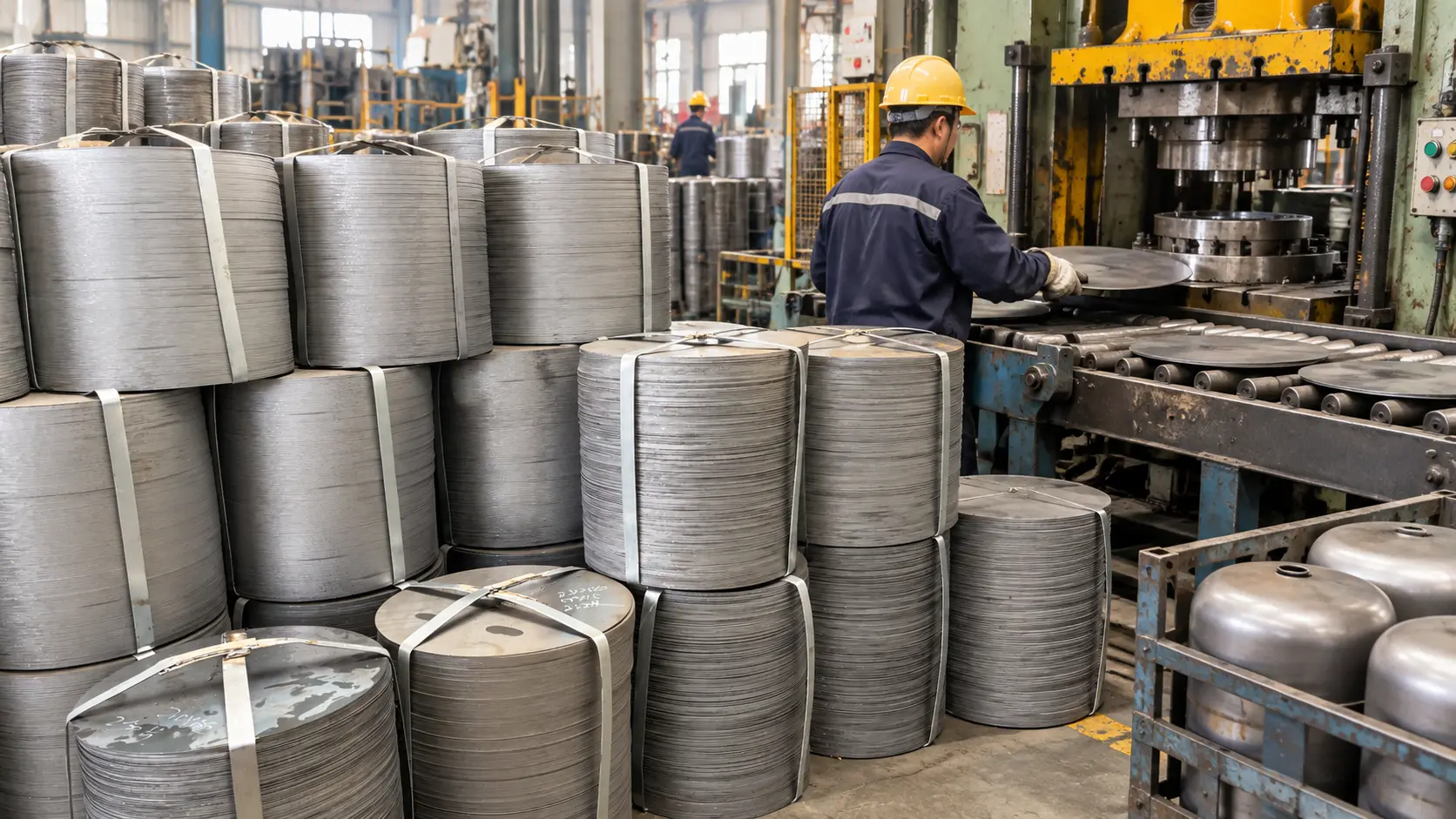
An LPG cylinder begins as flat steel, but the reliability of the finished pressure vessel is decided long before welding, coating, or valve fitting. The steel disc, or blank, must be cut from coil or sheet with controlled geometry, then formed into a deep-drawn half that can be joined into a leak-tight shell. For buyers and production engineers, understanding this route makes it easier to compare material, blanking, forming, and inspection requirements without confusing a raw component with a finished cylinder.
An LPG cylinder steel disc is a circular blank cut from pressure-vessel-grade sheet or coil. It is the starting workpiece for a cylinder end or body half in many welded-cylinder production routes. The blank diameter, thickness, edge condition, and flatness determine how much metal is available for the wall, shoulder, and base transitions after forming. A disc is therefore not just a round plate: it is a process input that carries dimensional and metallurgical requirements into every downstream operation.
The term is sometimes mixed with “steel plate,” “round blank,” or “disc blank.” In procurement documents, define whether the supplier is offering coil, slit sheet, pre-cut discs, or a complete blanking service. That distinction affects nesting, scrap, handling, and the responsibility for first-piece approval.
Coil blanking normally follows a controlled sequence. The coil is uncoiled and leveled, then fed to a press or cutting line. A die cuts circular blanks, while the line manages indexing, lubrication, part transfer, and scrap collection. When the blank diameter is matched to the drawing layout, the process reduces trimming allowance and avoids carrying unnecessary steel into the press.
Good blanking control starts with the incoming coil. Mill certificates, heat identification, thickness checks, surface inspection, and flatness verification should be connected to the production lot. Operators then check blank diameter, burr direction, edge damage, and out-of-roundness. A burr that seems minor at blanking can become a crack initiator during drawing, especially when the edge is pulled through a die radius.
For high-volume LPG cylinder production, automated disc blanking can improve repeatability and material utilization. The exact line arrangement, press capacity, and blanking tolerance must be matched to the cylinder design and the supplier’s validated process; they should not be assumed from a generic equipment description.
Deep drawing uses a punch, die, and blank holder to transform a flat disc into a cup-like shell. The punch pushes the blank into the die while the holder controls material flow. Too little restraint can create wrinkles; too much restraint can cause tearing or excessive thinning. Lubrication, tool radii, press speed, and material formability all influence the result.
The first draw establishes the basic wall and base geometry. Depending on the design, one or more redraws, ironing operations, or local forming steps may follow. Between operations, the manufacturer may inspect wall thickness, height, diameter, concentricity, and surface condition. The aim is a stable shell that can be trimmed, welded, and finished without introducing hidden defects.
Deep drawing is different from simple stamping. Stamping may cut or shallow-form a part in one hit, while deep drawing deliberately moves material over a greater depth-to-diameter relationship. The correct process window depends on steel grade, thickness, blank size, tooling, and the required cylinder geometry.
A practical incoming inspection plan connects the disc to the finished cylinder’s duty. Verify the material designation and heat traceability, then measure thickness at representative points rather than relying on a single reading. Check diameter, roundness, burrs, scratches, rust, and edge laminations. If the cylinder design is sensitive to anisotropy or directional properties, confirm that coil orientation and forming direction are controlled in the process documentation.
After drawing, inspect the shell for wrinkles, splits, orange-peel texture, thinning, uneven height, and residual distortion. Dimensional gauges should reflect the drawing and welding datums, not only a nominal outside diameter. Non-destructive testing, pressure testing, and final acceptance criteria belong to the complete cylinder quality plan and should be agreed against the applicable market specification.
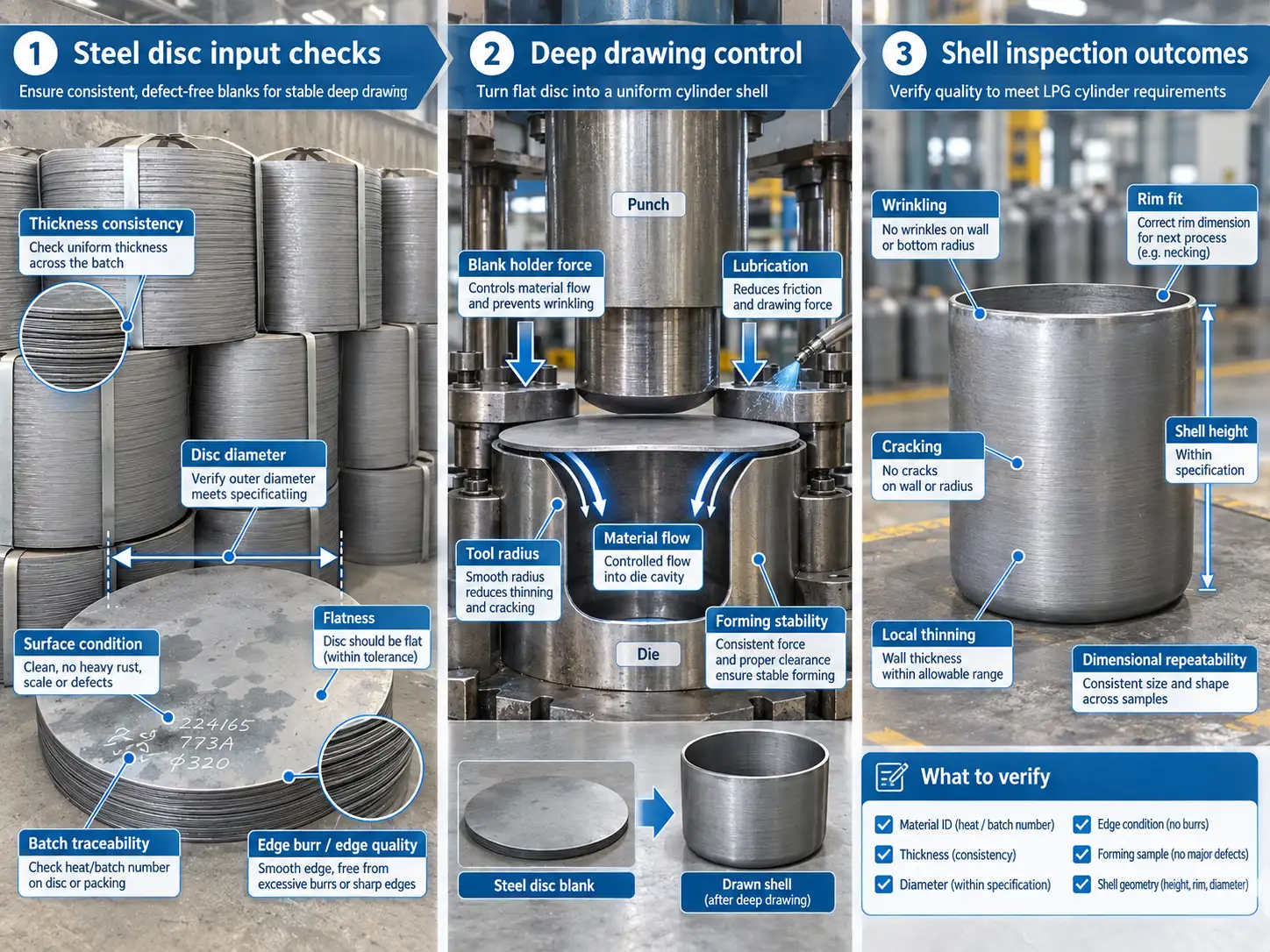
Cracks at the shoulder or wall often point to excessive strain, poor lubrication, sharp tooling, unsuitable blank size, or material variation. Wrinkles usually indicate uncontrolled compression or insufficient blank-holder force. Earing, where the cup edge rises unevenly, is associated with planar anisotropy and may require trimming or a revised forming strategy. Surface scoring can come from contaminated lubricant, damaged tooling, or poor blank handling.
The most effective response is to trace the defect backward: identify the press stroke, tool set, heat number, blanking batch, lubricant condition, and inspection record. Corrective action should be validated on a controlled trial and then locked into the work instruction. Reworking a visibly defective shell without understanding the forming cause can transfer risk to welding or service.
A clear RFQ should state the cylinder application, drawing or blank diameter, material grade, thickness range, tolerance, surface condition, edge requirements, quantity, packaging, and required inspection documents. Also state whether the supplier must provide pre-cut discs, coil, or a complete disc-blanking operation. If the discs will be deep drawn by a different plant, include the forming method and any known draw-depth or trimming constraints.
Ask for representative samples, a dimensional inspection report, heat traceability, and the proposed change-control method. Confirm how nonconforming discs are segregated and how replacement lots are identified. These details are more useful than a broad claim that a disc is “high quality,” because they show whether the supplier can maintain consistency from coil receipt through forming.
Mintai Cylinder focuses on the research and manufacturing of LPG cylinders and describes an integrated model covering R&D, production, sales, and service. Its public company information states that the Hangzhou facility operates automated production lines and serves LPG-cylinder markets. For a project that starts with steel discs and ends with finished cylinders, the useful next step is to confirm the required cylinder design, material route, blank dimensions, and inspection plan with the technical team.
You can review the company’s LPG cylinder manufacturing focus and its service support for the appropriate project context. For a quotation or fit check, contacter l'équipe technique with the model, dimensions, material, quantity, operating conditions, and any available drawing.
LPG cylinder steel discs sit at the intersection of material control and forming engineering. Coil blanking establishes the repeatable starting geometry; deep drawing converts that blank into a controlled shell; inspection confirms that the shell is ready for trimming, welding, and final qualification. Buyers who specify traceability, dimensional tolerances, edge quality, and forming conditions can compare suppliers on process capability rather than on a disc’s appearance alone.
A steel disc is a flat blank used as a forming input. A finished LPG cylinder includes formed shells, welded joints, fittings, surface treatment, and the inspections required for its intended market.
Blank diameter controls the material available for the drawn wall, shoulder, and base. An unsuitable diameter can increase thinning, wrinkles, trimming loss, or dimensional instability.
No. Formability depends on grade, thickness, surface condition, directional properties, tooling, lubrication, and the cylinder design. The material route should be validated for the specific application.
Include the drawing or blank size, grade, thickness, tolerances, edge condition, quantity, traceability, inspection documents, packaging, and whether the quote covers coil, pre-cut discs, or blanking service.